

 Search
Review Editing
Review of Planescape Campaign Setting
 Goto [ Index ] |
Is it everything I remember it to be? Almost. The Tony DiTerlizzi art is still beautiful and interesting. Over time, though, I had mentally added more color than there really is. So much of it is rendered in gray/brown hues. There's also the huge caveat regarding Planescape's place among settings. The line taken is one of PS's superiority over all the settings of the Prime material plane. Characters created outside of PS are referred to as being "clueless." Of course, this was done in jest by the authors. Once I had to explain that to two people engaged in a shouting match because one person had suggested vulgarly that Elminster was a part of the female anatomy in comparison with what existed on the planes. The other person worshipped the old mage with frightening devotion. Don't show the setting to high-strung players with a serious attachment to any of the Prime Material settings.
As a setting, Planescape is something genuinely original and different. It's not just a world with a different attitude toward deities or more dragons. Planescape puts amazing settings full of ash, water, demons, and clockwork at the disposal of the DM. The variety is so great that campaigns could be constant sources of wonder and amazement for years to come. Whereas years of playing in a setting can leave the characters and players jaded and leaning toward power gaming, Sigil and the planes are designed around a Renaissance ideal of exploration and making the characters more worldly (planar?).
At the center of the planes stands the city of Sigil. From Sigil, all worlds and planes can be reached. The boxed set covers Sigil and describes the planes around it. The Prime material worlds, such as Oerth, Toril, and Krynn, Athas, etc. don't get covered. They got detailed in their respective gaming supplements. Compared with the new settings added in the boxed set, players aren't likely to notice if the DM doesn't include any Prime worlds.
The box includes a player's guide, a DM's guide, a book on the setting, a monstrous compendium supplement, and a DM screen featuring the Lady of Pain's stoic countenance. The player's guide is a good idea. At 32 pages, though, it was far too thin to be effective. For planar characters, a read through the setting book is almost essential for them to effectively play a character familiar with the planes. Too bad the setting book has NPCs and such that players shouldn't see. The DM's guide also contains things some players should read, but it is in the same boat as the setting guide.
A point has to be made of the fact that PS isn't the best setting for people new to AD&D, or role-playing in general. There are many new rules, terms and concepts to grasp, beyond the arcane THAC0 and multi-class concerns. Beginners are likely to be overwhelmed. TSR had labeled PS as an advanced setting in their catalog, and that fact is to be seriously considered.
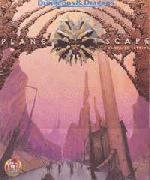
By and large, Planescape is the most beautifully rendered AD&D setting ever. The art alone conveys more sense of wonder than any fantasy gaming product I have ever seen. From the Robh Ruppel cover to the evocative Tony DiTerlizzi renderings of faction members, the work on this was top drawer. The rust and verdigris stucco looks cool but gets tired very quickly. At least they perpetuate the theme of antiquity and beauty within the planes. The maps were nice, with the exception of the map of Sigil, the donut atop an infinite spire. Other art and descriptions form the city into a medieval fantasy metropolis cluttered with buildings piled on top of each other. Shades of Venice and London abound. So what was the city's map artist reading? Sigil is reduced to a ring of loosely scattered, rudely rendered villages. On the back of the map is a large B&W picture of the city, as if to counter and correct the presentation on the front side.
Is Planescape recommended? Very much so. It's the first world AD&D setting since Ravenloft to feel like something more than just a warped Middle Earth. Planescape should be a source of wonder and fun for years to come. Just don't slight any inhabitants of Toril while describing it. That may be a touchy subject.
Style: 5 (Excellent!)
Substance: 4 (Meaty)

