

 Search
Review Editing
Review of Stormbringer Fifth Edition
 Goto [ Index ] |
Part I: Bias Although I'm absolutely nuts over Tolkien, I think that most fantasy is terminally lame (by which I mean "passionless and hackneyed"). I'm not a big fan of Moorcock (I thought Corum was alright), and in particular I dislike the character of Elric (I think he's a big jerk, really). As far as systems go, I like ones promoting realistic and logical results. I really like Chaosium's BRP system (which the game uses with a few nice tweaks), in particular the deadliness of the combat. I feel this makes things more dramatic.
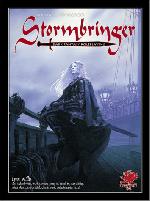
Part II: The artifact The book, looking dark and imposing with a nice cover by John Snyder, is just over 300 pages. The back cover has some iconic representations relevant to the setting: the scales of Balance, the asterisk-thingy of Chaos and the arrow of Law (from the Tiwaz rune?). The book is a softcover with reasonable-quality paper and black-and-white interior printing and art. The art at the beginning of each chapter is full-page, with a few pictures here and there in the text. The interior art varies in quality, but I thought it was mostly good. In the back is a four-page section listing other Chaosium products, as well as three more pages of advertisements. There is a useful table of contents and a good index, as well as a section of frequently-used charts and a character sheet.
Part III: Content Section A: Overall organization There are 12 unnumbered sections or chapters, each dealing with setting or mechanics information. Some information is presented in sidebars, and the interior sections are clearly labeled. One problem I identified was the curious scheme by which things are organized in this book. The mechanics for Allegiance Points, arguably the most important mechanics of the game, are mostly (pp. 65-69) in the chapter on character creation (called "Adventurers"); but a very important table is located in the "Gamemasters" chapter (p. 261). Similarly, the injury rules (pp. 104-106) are located in the "Game System" chapter (including the rather important Major Wounds Effects table on p. 105), and not in the "Combat" chapter, so there might be some flipping back and forth. I consider this a minor flaw, but still notable.
Section B: Setting The setting of this game (the Million Spheres in which Law and Chaos fight) is not exactly the same as the main game world (the Young Kingdoms), since the setting admits of many worlds. I am calling the Young Kingdoms the main game world because it is the only world detailed in the rules. You can make up others as you see fit, and Darcsyde (a different company) has produced another world ("Corum", or the world of the Five Planes) and has plans for a second one ("Hawkmoon"). There are also a variety of methods for travelling between worlds which fit perfectly with the setting (such as the Dark Ship which sails between worlds, detailed in the Seas of Fate supplement; or Chaos Gates from the Bronze Grimoire; or anything else you might make up).
The basic premise of the setting is the eternal war between the forces of Law and Chaos. Chaos, the more aggressive force, is the source of creativity and change. It is also the source of violent oppression and wasteful destruction. The Lords of Chaos are a group of selfish liars who ultimately only seek to spread their power over all planes of existence. Law, the more enduring force, is the source of protection and stability. It is also the source of slavish conformity and sterile banality. The Lords of Law are a group of cosmic stuffed-shirts who ultimately only seek to spread their power over all planes of existence. These two forces have an implacable hatred of one another, and entire planes of existence are laid waste in their conflicts. There is also the Balance, which denies both Law and Chaos (rather than being merely an amalgam of both). Whereas the previous two struggle to gain power, in many ways Balance seeks to renounce power. Balance champions the natural over the artificial, liberty over tyranny, and views charity as an end. Its path is by far the most exacting to follow.
Where do characters fit into this? Well, each character has Allegiance points for each of the forces. You generally start play with a few in one of the three, but a character is likely to gain points in the others as well. There are two ways in which points are gained. First of all, certain individual actions add points to a character's total. Killing a sworn foe in a fair fight gains you a Law point, as does jailing a criminal. Learning and casting magic gain Chaos points, as do acts such as murder and significant theft. Balance points are gained by giving charity, falling in love, and other such forms of openness. The other way to gain points comes after the adventure, when the GM may instruct players to roll for an increase in the force they served most significantly (at the GM's option).
A character whose allegiance to one force gets well beyond the others may become an agent of that force. If so, he or she gets certain benefits, but needs to roleplay the allegiance and stands open to building up points in that force rather rapidly. Eventually, a character who has passed a certain threshold of points and has extreme devotion to a force may become a champion of that force. Champions gain great powers, and each power is tailored to the philosophy of the force in question.
One curiosity about gaining allegiance is the question of whether a Chaos point is gained whenever a spell is cast. The question actually came up in a posting of the Chaosium Digest (I don't know the year, but I presume that it was a while ago), in which Lynn Willis himself (the game designer) actually confirms that a character gains one Chaos point per casting. This was apparently not clear in the earlier rules, and by my reading of the current text it is still not clear. I find it quite odd that they didn't address the question more plainly in the subsequent edition, since it is exactly the sort of thing a GM would want to know. Here's the link: http://www.geocities.com/Area51/Chamber/5004/digest/18.htm
Section C: World The game world is called the Young Kingdoms. Basically, the whole world was once united under the Bright Empire of the Melniboneans, a bunch of serious jerks with arrogance exceeded only by their magical prowess. Their culture is in total decline, however (they're mostly all drug addicts) and their former slaves (the humans) have broken away. The Melniboneans serve Chaos, whereas most humans embrace Law (with some notable exceptions). The humans have their petty squabbles and difficulties just like anybody, and most don't really worry about cosmic conflicts (except the evil men of Pan Tang, who also serve Chaos). The game is generally set about a year before the events of the Elric books take place. This is interesting because, at the end of those books, the world of the Young Kingdoms is totally destroyed. So the characters in the game (if you play according to this timeline) have about seven or eight years to live before they too reap the whirlwind of the war of Law and Chaos.
Of course, characters could change things, or you could set the game earlier in the timeline (nothing much has changed in the last 50 or 100 years, for instance) to avoid the issue. You could also give the characters the opportunity to escape the fate of the Young Kingdoms through travel to another of the Million Spheres. Assuming, of course, you are feeling generous. I think that this sort of 'refugee' plotline could be intriguing. On the other hand, everybody has to die eventually anyway. One thing the world offers is the ability to explore the question of how characters will behave once they see the writing on the wall (there are some nice touches, too, like a spell in the Bronze Grimoire supplement which allows a seer to determine if a lad of under 15 is destined to future greatness; a few years before the end it mysteriously stops working). Sort of a question of morality and meaning in the face of annihilation (a meditation on mortality, perhaps).
One thing that is lacking in the game world information, however, is a timeline. Like with numbers. My thought processes really benefit from the availability of numbers. The game notes that you can follow along with the events of the books as they change the course of the world, and although they do give nice synopses of the books, it is hard to tell exactly what happens when. They rectify this a little bit (for the Northern Continent, that is) in the Atlas of the Young Kingdoms vol. 1 (the only volume published), but it would have been tremendously helpful if they could have made it all clear in the rulebook itself.
Section D: Game System The game uses Chaosium's Basic Roleplaying system. If you've played Call of Cthulhu, for instance, you already know most of the rules. Characters have a number of attributes on (in this version) a 2D6 6 scale (the rules say to roll characters randomly and discard stat sets you don't like; I often allow players to simply pick stats as seems proper), which can be rolled against on D100 according to a multiplier (usually x5 for routine tasks). Most important are skills, which are expressed as a percentile and rolled against on D100. Easy.
In this version of BRP, you can have skills over 100% (in fact, it's a really good idea). This is important because if you roll 1/5 or less of your skill on D100, that is a critical success. For example, if you are trying to hide from a guard, and the guard thinks you really are in the area you are hiding in and so is actively searching, and you each have skills of 100% (he's a very observant guard), it would seem that you will both succeed (in which case he sees you). But if you roll a 20% or under (and he does not), you get a critical and so escape detection. Now, if he wasn't actively looking, the GM would have to roll a critical result for him to notice you, and if your roll was a critical then there would be no chance of casual detection. Other opposed rolls work similarly (like dodges and parries and so on). Skills have no maximum, and the higher they get, the more often a critical is rolled.
Section E: Magic There are two basic types of sorcerous pursuits in this game. The first involves the casting of rote spells, which are fairly interesting and quite powerful in the hands of someone who knows how to use them. The spells range from increasing attributes and skills to combat spells to utility spells of various kinds. The second type involves summoning demons (it's just a game, calm down). These creatures (they're actually just really mean aliens) can be made to serve the sorcerer, or even be bound into objects and thus make their powers available to the controller of the artifact. The sorcerer defines the sort of creature he needs in the casting, and there is an extensive list of powers he can give it for purposes of customization (these all cost magic points, of course). From a GM's standpoint, I can't wait to use the Summoning Fumble Table, in which power-hungry players can accidently make starry void gates out of which bad stuff crawls at random intervals, get turned inside out, and become afflicted with an assortment of other yucky things. Maybe it says something bad about me as a person that I enjoy seeing spell-casting characters get mutilated (or maybe it's just from playing too much CoC).
Section F: Combat Combat is fast-paced, almost swashbuckling in flavour, and very deadly. You normally get one attack per round, plus as many parries and dodges as you want (but at a cumulative -30% penalty after the first). A critical attack (20% or less of skill) can bypass a non-critical dodge or parry. Attacks over 100% can also be split into multiple attacks (of at least 50% each). So, with skilled fighters (100% combat skills), you generally have a flurry of blows, most of which hit but are parried or dodged, until somebody finds an opening (critical attack vs. non-critical dodge or parry) and delivers an often massive blow. Critical hits vs. missed defense rolls generally result in double damage.
Characters have hit points, and attacks which do more than half hit points in a single strike do a major wound (you roll on a table), which puts a serious hurting on the defender (attribute penalties, scars and other inconveniences). The defender also has only a limited time before succumbing to shock. A bunch of small wounds can build up to the major wound effect of unconsciousness (avoided by a roll), but you don't have to roll on the table in that case anyway.
Armour is quite cool in this game. In other versions of BRP, some weapons simply can't scratch some armours, which is frustrating. That is not the case here. In Stormbringer, armour has a *roll*. For instance, Half Plate Mail rolls 1D8 2 to see how much it blocks on a particular hit. So, if you roll low, the enemy found an articulation or other weakness. A high roll is the thickest part of the armour. The only complaint I have here is that, if you don't wear a helmet, armour stops one less point of damage. That just seems a little too abstract to me. It seems to me that either they hit the head, or they don't. I would instead allow "called shots" to the head (at, say, 1/2 skill), in which case the blow would find no intervening armour unless a helmet is worn.
Section G: Other Stuff The book also includes a bestiary, although a lot of the entries are rather limited in utility (a number of unique or very specialized critters); the game doesn't focus on monsters anyhow. There is a very useful "digest", with sample NPCs from all walks of life (so you don't have to design mercenaries, guardsmen, nobles and peasants all the time). There is a listing of the various characters from the books and their stats, which is necessary but maybe not all that useful. There is a section for Game Masters which offers some advice, and some sample magic items (as well as a large list of 'rumoured' items which the GM can design). Finally, there are two adventures. "The Weight of Doom", the first one, is rather overt, a simple-minded mishandling of the main theme of the game, Law-Chaos-Balance. Basically, various agents of the forces show up and canvass the characters for support. I think this adventure is silly. "The Thought that Counts", on the other hand, is fairly good if short. The PCs have to bring a valuable statue to their employer from a rather shady fellow, only to find that it is not easy to keep hold of. Nothing earth-shaking, but a good introduction.
Part IV: PAQ "Is this edition much different from 'ELRIC!'?" and "Is it much different from 'Dragon Lords of Melnibone'?" Not that much, as far as I can tell. As for ELRIC!, there is more information on religion in the Young Kingdoms, Melniboneans are less powerful as characters, Slaves of Melnibone and Half Melniboneans are introduced as characters, and a few rules (drowning, fighting in low light) have been altered. Also, "Stormbringer" is a much cooler title than "ELRIC!", which always seems like shouting if you post it on the net. As far as DLOM goes, much of the text seems to be the same. But if you buy Stormbringer, you get to use BRP!
"Is it a complete game, or do I need supplements?" It is complete and has all you need to play. A couple of the supplements are fun if you like new rules (Sailing on the Seas of Fate, for maritime stuff) or new spells (the Bronze Grimoire, but it's out of print so work fast). I suggest both of these supplements, actually. Published adventures are also available.
"Are the characters in Stormbringer as hosed as they are in CoC?" No, they're not totally hosed. Until things go "boom", anyway (but see above). The game is brutal, however; but for me that's a selling point. I like literary conflict, violence especially, to be visceral and realistic; it makes for a more powerful story that way. Plus, white-washing violence seems to me to be an irresponsible handling of a very serious subject. Good cause or not, at the end of the day violence is still a form of abusing another human being. So it probably should be shown as such. Anyway, although the game is about as apocalyptic as CoC, it is not quite as desperate.
"What's the learning curve?" If you've played other BRP games, almost none. If you are new to Chaosium games, it is still easy but there might be a few points of confusion due to the poor organization of the rules materials (spread out in strange ways and therefore sometimes potentially obscure). Don't worry, though.
Part V: Summary This game is an excellent example of dark fantasy, and one of the best fantasy games I've seen. The system is good, the embellishments are cool, and the setting is thought-provoking. Even at 30$ (more or less my upper limit), the game is still a great value. The Lords of Law command you to buy it immediately.

