

 Search
Review Editing
Review of Godlike
 Goto [ Index ] |
At GenCon this year I was fortunate enough to participate in a demo for Godlike with the awesome Greg Stolze as GM. Over the years Greg has contributed to Unknown Armies, Feng Shui, Trinity, Delta Green and the just released Adventure! among others. With Godlike, Greg teams up with the talented Dennis Detwiller (of Delta Green fame) to bring us a game true to the spirit of Pagan Publishing. Given that Godlike is not published yet, my information is limited to what I could think of asking Dennis and Greg at the time, a small two-page flier, a mock up of the rulebook that I paged through for a couple of minutes and the website (http://www.tccorp.com/godlike/).
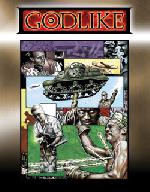
So what is Godlike about anyway? In the words of the creator Godlike is “superhero roleplaying in a world on fire: 1936-1946”. In a crowded field of games with superheroes as the central theme this latest entry provides a new version with so many twists that it can’t fairly be compared with the rest of them. In Godlike you play the role of a superhero or “Talent”, a person with extraordinary abilities. Usually a member in the armed forces trying to combat the rising Nazi threat. Possible affiliations include playing a member of the Talent Operations Group of the U.S. Army, a member of Soviet Special Directive One or the Special Sciences Office of the British Forces. Think World War II with super heroes and you have a vague idea of what Godlike offers.
During the demo we played members of the Russian Army. Our task was to uncover the newest secret weapon of the Nazis, a Talent with the ability to turn all metal in a square mile to glass. With the help of a flying Talent with sonic powers, the Nazis reduced a Russian town to shards. The next target was a Soviet air base.
Our team of heroes was comprised of 4 Talents and 2 grunts (non-talents). We had a super strong (but not invulnerable) character. We had a commander who served as a jack-of-all-trades, skilled in many different tasks but master of none. We had a soldier who could create doubles of himself one at a time. Great to use as bait. My character could kill any non-Talent just by staring at them. On the downside we could all be killed by a single gunshot.
I don’t want to give away the whole plot, as I’m not sure whether or not the adventure will be included in the rulebook. Suffice it to say that we had a blast. Tanks, snipers, gun emplacements and bunkers only begin to describe what our brave heroes had to endure.
Although WWII is not new to superhero RPG’s (Brave New World and, I believe, Champions both have supplements with “golden age” as the theme) Godlike gives the time period a very different feel. Games like Champions simulate characters in a cartoon or comic book. Godlike is like playing skilled soldier storming the beaches in Apocalypse Now. Gritty in the extreme, it offers thrills the likes of which you can’t find in most current RPG’s. The writers realize that not everyone likes complete realism. For this reason the game also looks to satisfy a variety of play styles. Although the default system is on the gritty side, options for four-color and cinematic campaigns will be included. Fans of masks, costumes and tights however, are encouraged to look elsewhere.
The rules system is solid, uncomplicated and fairly straightforward. Skill resolution is determined by rolling the number of dice equal to your skill. Unlike other methods, you do not compare your rolls against a set number or difficulty rating. Instead you count the number of pairs, triples, etc rolled. A success is scored for each pair. Triples are even better.
Instead of hit points each PC has a diagram resembling a stick figure made of boxes representing the different parts of the body (head, torso, right arm, left arm. right leg and left leg). Depending on where damage hits, the character can continue to act or not. For example, if enough damage is taken to the right leg the character won’t be able to walk. This may also affect other skills depending on the quantity and type of damage scored. The head, for example, can sustain only four wounds. After that the character is dead. Each arm or leg on the other hand, can take five or six hits before becoming useless.
Superpowers are also different from your run of the mill supers game. Keeping in mind the limited exposure I’ve had of the system, I can tell you that Talents usually have a single power and not a combination of powers. Take for example our super strong character. Yes, he could lift four tons over his head but that did not mean that he could withstand a bullet any better than you common infantryman. Strong does not mean tough. Personally I see this as an added feature. It gives each character an opportunity to shine under different circumstances.
Powers vary widely. The web site has mention of a Talent who could “lift things with his shadow”, and another “who could link any two doorways with the power of his mind, despite the distance between them.” During the scenario Greg made use of a special kind of Talent, one that could dampen or nullify the powers of other talents. Thus explaining why the allied Talents had not killed Hitler or Stalin.
If I remember correctly the book will be over two hundred fifty pages, retail for about $30.00 and due out sometime in September. Dennis Detwiller wrote the setting material. Greg Stolze wrote the rules system. Paging through the mock up I got the impression that the rulebook will have a high word count. Pagan has always been a good value for the money. I don’t think that will change with Godlike. The artwork will be provided by none other than Dennis himself. Anyone who is not familiar with his artistic skills need only look to other Pagan Publishing books to see the quality of his work. Dennis has also provided artwork for Unknown Armies and even Magic: the Gathering.
Giving a substance score to Godlike seems a bit inappropriate at this point. However, just going on what I’ve seen it appears to merit at least a 4 if not higher based on the sheer quantity of information contained. Historical and campaign descriptions, power listings, NPC descriptions, statistics for many of the weapons and vehicles used by all sides during the conflict, all this and more is included.
As far as style is concerned Godlike has it in spades. Anything short of a 5 would be silly. You have one of the most interesting periods in modern history combined with some of the most interesting protagonists to play in such a setting. Setting and character, what more can one ask for? Add to that two of the most talented game designers in the business and you have a recipe for success. I had a blast with it. I think you will too.

