

 Search
Review Editing
Review of Star Wars Core Rulebook
 Goto [ Index ] |
Character types have included one corporate bootlicker turned merchant prince, one bitter pilot fleeing an irate ex-husband, one combat techie with a fiendish sense of humor, and one soldier who kills stuff good played by the party munchkin. NPCs have included just about every archetype from the Star Wars universe, from bounty hunters to smugglers to Imperial aces, so I feel qualified to comment on most of the character types presented in the book. However, the Force has not played any real part in the game, and my commentary on the Force rules will be based on only a reading of the rules, not any in-game knowledge.
Further, know that I grew up on the D6 system, on which the old Star Wars system was based. While I did not want to have the designer's love child, I liked the system a whole lot, and it was my gaming group's de facto system for many years.
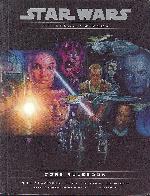
First, let's have a look at the rule book itself. It's a glossy hardcover featuring the prequel characters on the front and the trilogy characters on the back, about the same size and shape as the new D&D Player's Handbook, with 318 glossy, full-color pages. The book is divided into three main sections: an introduction, player information, and game master information, each conveniently color-coded.
The art is mostly stills from the trilogy and the prequel, with some drawings thrown in. There's plenty of art, and the text is arranged in a pleasing fashion. The whole package is very professional-looking, with the stills being excellent and the drawings acceptable.
There are 16 chapters in total, each of which opens with a well-done and appropriate still from one of the movies, from Qui-Gonn and Obi-Wan leaping out of the gas with their lightsabres for the Force chapter, to the Imperial brass sitting around that table in the first Death Star for the Game Mastering section (it kinda looks like Darth Vader's GMing, and that big black sphere in the table is full of dip, so it's appropriate, I think).
Starting Stuff:
The introduction does a good job of describing the basics of the role-playing game, and points out the three eras of play available (the Rise of the Empire, the Rebellion Era, and the New Jedi Order Era). It's here we see that the new Star Wars rules are definitely a variant of the D&D rules. Characters have levels, classes, the six standard ability scores (strength, dexterity, constitution, intelligence, wisdom, and charisma), skills, feats, and other trappings of D&D, ported over to Star Wars.
After a crash-course on ability scores, the next pages have templates: three 1st-level characters of each class, with all the system information already filled in. The characters are clearly modeled after characters in the movies. The templates are useful: while all my players created their own unique PCs, at the lower levels, I could use these templates as stock enemies: two trandoshan bodyguards and a human royal make excellent foes for a party.
The introduction, in fact, makes a fairly good quick-start for the players, and so long as the GM knows the other rules, he can probably have a game up and running in five minutes just by allowing the players to read the intro and choose templates.
Chapter 1: Abilities
After all the introductory stuff, we finally get to abilities, complete with picture of our two intrepid Jedi battling Darth Maul. You know the drill: strength, dexterity, constitution, intelligence, wisdom, charisma. Roll 'em, spread points for 'em, or just lie to the GM, whatever way, they typically range from 3 to 18, with 10 being human average.
Chapter 2: Species
Now, we get the species list, featuring, I think, a generic shot of Tatooine from the prequel-whatever it is, it's not the cantina scene, so shame on them. We have available to us: humans, cereans, ewoks, gungans, ithorians, mon calamari, rodians, sullustans, trandoshans, twi'liks, and wookiees.
All species except for humans have ability score adjustments. An ewok, for example, has a 2 to dexterity and a -2 to strength, while a mon calamari has a 2 to intelligence but a -2 to constitution. This is good, except that the designers assume that strength and dexterity are the "superior" stats, with each bonus to one of them requiring a penalty to two "inferior" stats. This puts Wookiees, with their immense strength ( 4) at a disadvantage, although given that most of Star Wars combat is shooting blasters (based on dex, not strength), strength doesn't have the advantage that it does in D&D, and it's odd that they still chose to weight the stat that way. The stat weighting indicates an expectation for a particular style of play, I think. I simply re-wrote it so that all stats were equal, and modified appropriately.
Chapter 3: Classes
Next, we move onto character classes, with a picture of Leia, Han, Luke (complete with stupid expression) and Chewy on Hoth. There are eight PC classes: fringers (like Luke at the beginning of A New Hope), nobles (like Leia), scoundrels (like Han and Lando), Scouts (like Chewbacca), soldiers (like Wedge Antilles), force adepts (alternative force-users with a mystical bent), Jedi consulars (diplomatic Jedi, like Yoda), and jedi Guardians (butt-whoopin' Jedi, like Obi-Wan).
Classes in Star Wars seem more to be like social stations than jobs. This may look like there'd be some problems with maintaining niches, though I have found this not to be so. Over time, the characters in my game have all become fairly handy with a blaster, and most of them have learned to fly a starship. However, the pilot still outshines them all while flying, and the soldier can still mow down stormtroopers far better than anyone else. While characters seem to have more general competence than D&D characters, they do not by any means have identical abilities. Rather, most share a few basic abilities (repair, blasters, and piloting) at roughly equal levels, with individual characters excelling in one or two specific areas. This seems right for the Star Wars universe: characters don't have to multiclass and fiddle in order to get the characters that they want.
On the down side, since the function of each class is not immediately apparent, it takes a while to figure out what sort of character class fits your concept. This is a problem in D&D, where if you say that you want to be a street urchin, then poof, you're a rogue--not a ranger, not a monk. However, under the new Star Wars rules, if you want to be a corporate shill, what are you? A noble? A scoundrel? If you're a pilot, what are you? A fringer? A scout? A soldier? You need to look a bit harder to get what you want.
Star Wars is not just a class system, of course; it is also a class/level system. Characters start at 1st level and can go up to 20th. Every increase in level gives the character more skill points, more vitality points (hit points--more on those later), and attack bonuses, as well as a raised Defense (in Star Wars, a character's armor class, or ability not to get hit, improves with level). All in all, I have no problems with the level system. Further, it allows me to gauge the relative esteem that the characters will be held by the Galaxy.
Chapter Four: Skills
Here, we get the skill rules, after a picture of Chewy repairing the Falcon on Hoth. First, we learn how to use skills: roll D20, and add to it the number of ranks the character has in the skill, the modifier for the appropriate ability score, and any miscellaneous modifiers, and beat a GM-assigned difficulty number, typically ranging from 10 to 40 or so. If you're competing against someone (say, you're trying to sneak by a guard), you both make rolls (in this case, it would be your Stealth and his Spot), with the higher roll winning.
Characters get skills based on their class and intelligence, with humans earning a few more. You usually get quite a few skill points at character creation, but the maximum rank you can have in a skill is equal to 3 your level, so you can't just dump all 24 of your starting points into, say, Pilot.
Skills that are pertinent to your class (Move Silently for a scout, Demolitions for a soldier, Handle Animal for a fringer) cost 1 skill point per rank. Cross-class skills cost double this, and your maximum score in cross-class skills is half what it can be in your class skills. This works nicely as a form of niche protection, and keeps the character concepts more focused than they otherwise would be.
Here, we also get the Force-based skills. It looks as if WotC used an outline of the D6 Force rules, with the division of Force powers into Control, Sense, and Alter. It is the opinion of this reviewer that the Force rules in the old Star Wars game were not just the worst rules in the game, but possibly the worst rules in any game, barring the GM cheating rules in Synnabar. I have no idea why WotC is using these.
Regardless, we have a bunch of skills here, like Affect Mind ("These aren't the droids you're looking for."), Telepathy ("Leia, hear me!"), and Force Grip ("Your lack of faith disturbs me."). Skills require a roll and expend Vitality points, which means that the force user grows fatigued the more he uses his powers.
Chater Five: Feats
The feats chapter, featuring Han blowing away Greedo in the cantina, introduces various nifty powers that characters can get. Characters typically get one feat at first level, and another feat at every third level. This chapter has a whole lot of feats, with proficiencies, benefits, and special modifiers. Feats like Cleave (scythe down multiple foes) and Gearhead (bonuses to Repair and Computer Use) help round out a character.
We also get Force feats here, from Control, Sense, and Alter, to Deflect Blasters to Throw Lightsabre. Again, I can't comment much, except to say that there aren't too many of them--Jedi deserve more nifties than the few given.
Feats are, in my opinion, great: they give your characters an additional level of uniqueness beyond your classes and skills. Want to be a fantastic pilot, above and beyond your level? Take Skill Emphasis: Piloting and Spacer for a total of 5 to your Pilot beyond your regular maximum. Do you want to be the quickest gun in the Outer Rim Territories? How about Quick Draw and Improved Initiative. They're fun, they grant you kewl powerz, and they help define your character. Three cheers for feats!
Chapter 6: Heroic Characters
This seems to be the catch-all chapter for bits of rules about characters that don't go anywhere else. Next to a picture of the heroes of Episode IV at their victory celebration, we're asked to fill out information like our name, personality, background, goals, and appearance. We even get a free random age, height, and weight chart, as a throw back to, what, 1975?
We also get rules for Reputation. It goes up as you do heroic stuff, and may influence others' reactions. It seems tacked on, and I didn't use it much.
There are also rules for saving throws (resisting various physical and mental effects) and movement (for those who don't like hand-waving such things).
Chapter 7: Equipment
Blasters, lightsabres, credits, body armor, bacta tanks, and other staples of the Star Wars universe can be found in this chapter, which starts with a still of the stormtroopers finding droid parts on Tatooine.
First, we get "Wealth Beyond Credits," a thoroughly inadequate description of trading in the Star Wars universe. We get a few common trade goods, of which several have no information about how much they take up, coupled with a cost in credits. I had to haul out my Traveller 4 rules to get a working smuggler game going.
Next, weapons: we get a chart with information on damage, the attack number rolled needed to land a critical, and so forth. This is where we get another problem: it is much easier to drop someone with a blaster set on stun than to do so with one set to be lethal, under almost all circumstances, since stun blasts cause small amounts of damage and force a fortitude saving throw, with failure meaning that the character is out cold. Everyone was running around with their guns set to stun until I invoked the subdual rules from D&D and fixed that little fiasco.
The equipment chapter gives us another problem: armor. A character's Defense bonus comes from his class-based Defense bonus, although if he wears armor, he replaces that number with the armor modifier. This replicates the genre accurately--you don't see many high-level characters in Star Wars running around in armor-but it's perhaps not the best way to do so. Other than the obvious problem (that it's absurd), it also makes characters like Boba Fett (who are covered in armor) go all screwy, and it limits certain character concepts.
Chater 8: Combat
The combat system starts off with a big picture of Panaka and Amidala blazing away with their blasters, and two sample rounds of combat, which does a good job of explaining the basics of the system--or at least, I think it does. I've never had a problem figuring out game systems.
The combat system goes like so: first, everyone rolls 1d20 Dexterity, with highest going first. To attack, you roll 1d20 your base attack bonus your dexterity modifier (strength modifier for melee weapons) lots of miscellaneous modifiers; if you roll equal to or higher than your target's Defense, you hit. If you roll a natural 20 (or, for some weapons, a 19-20), you roll again, and if you roll another hit, you cause a critical.
A hit causes damage; you roll a fistfull of dice depending on the weapon, and subtract that from the target's Vitality Points. (Which is based on class and level-every level, you roll a number a die of a size based on your class and add it to your total.) Once reduced to zero Vitality, or if he only has gamemaster classes and thus has no Vitality, damage goes to Wound Points. (Which are equal to Constitution.) At this point, he has a chance of being knocked out, and suffers some penalties. Once someone reaches zero Wounds, they drop like a sack of wet oatmeal and may die. Critical hits cause damage that go right to Wounds, and since most weapons cause quite a bit of damage (3d6 for blaster pistols, 3d8 for blaster rifles), this can put a person down in one shot. So, basically, most tough heroes are willing to duke it out with a couple of storm troopers without feeling too nervous, but most are going to turn tail if they start taking too much fire, since a lucky shot could still drop them.
Other than the hit points, the whole combat system is a lot like the D&D rules; the one other big difference I noted is the lack of the Attack of Opportunity rules. Instead, if you're next to someone, you can't shoot your gun. Obviously.
There are lots of miscellaneous rules, like cover bonuses, defensive fighting, delaying actions, and so forth. We also get the Big Table of Multifire Modifiers. This is one of the game's little disaster areas: a colossal matrix filling up three-quarters of the page, so you can cross-reference your Base Attack Bonus with your feats with the number of shots that you want to take. This thing is hideous, inconvenient, unwieldy, and just shouldn't exist; I had to keep a finger on this page during every battle, and even then it took several seconds of processing to figure out the correct modifier. Further, even with this big ugly chart, there are no rules for full autofire, strafing fire, suppressive fire, and all the other stuff that the players love to try out in battle.
These multifire rules (along with the goofy "step back a foot; my gun stopped shooting" rule) seriously mar what is otherwise a good, fast-flowing combat system that does a pretty good job of simulating a Star Wars battle.
Chater Nine: The Force
As I said, the Force didn't arise at all during my game, so I can't comment on how it works. However, here's a description of the chapter. However, this is a more abstract discussion on the Force--the morality behind it, the philosophy of the Jedi, and so forth. This chapter contains nearly no rules, and is an excellent guide to understanding how the Force works in the game.
Chapter Ten: Vehicles
Here we get rules for vehicle combat, along with a few sample pictures and a picture of the Nemoidian troop carrier. Basically, you can perform a bunch of maneuvers, which require checks, and if you screw up the checks too much, you wrap your speeder around a radio transmitter. We also get a few sample vehicles.
Chapter Eleven: Starships
Here we have some of the worst starship combat rules I've encountered in a long time. But first things first: a picture of the X-Wings heading toward the first Death Star, starship costs, and chartering and buying ships. We get a Used Spaceship Chart, with all sorts of potential problems for a ship to have, which is very useful.
Next, it's time for rules on hyperspace--we even get a map of the entire Galaxy, and although it's very stylized and contains only the most important planets, it gives a good idea of distance and where things are. I found the hyperspace rules themselves to be needlessly complex; basically, it takes ten rounds to jump, and when you do, you look at a page full of modifiers to see if your ship makes it through.
While we get a description of a ship's systems, we realize that it means very little when we move onto the ship combat system, which, as I mentioned, is really crummy. Basically, you have a "bull's eye" with range increments from point-blank to sensor range, and front, back, left, and right displays, with your ship in the middle. You stick enemy ships around your ship, depending on where they are in relationship to it. As the ships move around, you move them around the display.
The system describes itself as "relative abstraction," and uses only vague descriptions of speed: docking speed, ramming speed, and so forth. This sounds wonderful until the player asks you how many rounds it'll take their X-Wing to reach a Calamari Cruiser's cover fire while being chased by three TIE Interceptors. Answer? Um, I dunno. Time is distance divided by speed, so that's…um…Kinda Far Away divided by Pretty Fast…where's my TI-82? Now, I'm not asking for the Babylon 5 space war game here, but I'd like to have something, even some basic ideas, to fall back on, or else I waste too much of my time trying to make something up-which is surprisingly hard using this bizarre system.
There're some other problems, too. There are rules for point defense weapons from capital ships, but they don't tell you how many point-defense guns capital ships have, or how much damage they do. The system uses "hull points" (hit points), which, while adequate, also replicate none of the excitement of a dog fight. Maybe it's because I grew up on Lucasarts' X-Wing games, but the first new rules I made were for system damage, if only to give the techies something to do during a dogfight.
The most crippling problem with the system, I found, is that it does not at all interact with human-scale combat. Here's an example: an X-Wing causes 5d10x2 points of hull damage (you have no idea how miserable this is to roll again and again-another problem). Since X-Wings have four cannons, a single cannon probably causes about 1d10x2 points of damage, maybe a bit more. Now, 1d10x2 damage averages to about 11 points of damage. A blaster rifle (3d8 damage) averages about 13 points of damage. This seems a bit funky to me, and got really weird when someone parked their X-Wing in a crippled Star Destroyer's fighter bay and started strafing storm troopers. Try telling him that his laser cannon just dented a storm trooper's armor-that doesn't go over well. The whole system just doesn't work: some ships are described as fire-linked, which is a pretty vague term, and whether or not guns are fire-linked doesn't seem to change much.
We finish off with far, far too few starships: X-wings, Y-Wings, TIE Fighters, Z-95s, YT-1300s, Guardians, Imperial Star Destroyers, Calamari Cruisers, Nebulon-B Frigates, and Corellion Corvettes. That's it for the triology vessels; not nearly an adequate sampling of vessels to come up with different ships; everything from Gthroc freighters to YT-2000s ended up looking essentially like YT-1300s. Now, for those of you who have no idea what I'm talking about, I assure you that this is a Very Bad Thing.
My vote for the space rules: dump them all. I essentially did, not because they bothered me (all rules bother me, and I'm tempted to fiddle with everything) but because the players were bothered by some of the absurdities and limitations. There just isn't enough to work with in the space rules, and what's there is unnecessarily confusing, nonsensical, and poorly thought out.
Chapter 12: Gamemastering Star Wars
This is a good little chapter on how to run Star Wars. It contains all the usual stuff: advice about encounters, handling the cruel vagaries of dice, crafting good descriptions, and lots more. The advice is useful, neither dumbed down nor overly academic, and should serve a new GM well, and provide a good refresher course for more experienced GMs in how to run Star Wars.
In this chapter we also get the prestige classes: just like in D&D, these are special classes that you can take if you meet certain stringent requirements. Bounty Hunters, Crimelords, Elite Troopers, Starfighter Aces, and Officers are all prestige classes. The prestige classes that came up (and come to think of it, all of them showed up in the game) worked well and were not inconsistent or unbalanced.
This chapter also gives us Gamemaster classes: commoners, diplomats, experts, and thugs. These are a lot like D&D's NPC classes, providing an easy means of creating non-adventurers like merchants, farmers, and cannon-fodder. GM-class characters' greatest difference is that they have no Vitality points. This means that while a 16th-level doctor, for example, may have astonishing abilities and be one of the best healers in the Galaxy, one or two shots will kill him. A similar principle applies for thugs (like stormtroopers): they may be really good shots and competent soldiers, but one well-placed blast and they're smoking boots. I made extensive use of GM classes throughout my campaign, eventually going so far as to make one of the party's goons, Gimbo, a pseudo-PC.
Finally in this chapter we get a list of How You Can Die Without a Stormtrooper Around: environmental hazards, from freezing to disease to falling off of high things. Nothing too wild here, but they work well.
Chapter 13: Eras of Play
Here we get run-downs of the three main eras in which you can play. Basically, there's Episode I, the Trilogy, and the Novels. We get character stats for just about all the main characters, from Darth Maul (what little twelve-year-old munchkin thought this…oh, in the movie? Oh yeah.) to Princess Leia, as well as two Obi-Wans. I suppose this type of stuff is useful to someone.
Chapter 14: Allies and Opponents
The first part of this chapter contains lots of species that just don't cut it as PC races for one reason or another: Bothans, Dugs, Noghri, and a few others, along with critters like wompa and mynocks. This stuff all seemed pretty good, although it didn't come up often in the game.
The second part of this chapter is the really important stuff. Here, we get samples of dozens of different character types, from administrators to traders and everything in between. This section gives full stats on each character type at levels 4, 8, and 12, with all the information already hard-coded in and ready to go. This was fantastically, incredibly useful beyond the power of words to describe. Need a pirate to throw at the party? Here it is. Need them to interact with some smugglers? No problem. This chart is an absolute lifesaver. Any game with rules more complex than R.I.S.U.S. should have these things set up and ready to go. They must have saved me hours of prep time and huge amounts of time during actual adventures. Three cheers for the sample character types.
Chapter 15: Droids
This is a surprisingly detailed chapter on droids, containing setting information like ownership laws and personalities as well as hard rules for designing your own droids. There are lots of (very good) rules for programming skills and selecting droid components, maintenance and design, complete with a big list of droid accessories and how much they cost. Great for techies. The only problem is that there's no attempt made at balancing droids with other characters; perhaps they're assumed to be NPCs.
We also get lots of sample droids, from our favorite Protocol and Astromech models to obscure and antiquated Treadwells and M-TDs, to the little square droid that says "Gomp" in the Sandcrawler (it's called an EG-6 Power Droid, apparently). We also get stats for battle droids (you can scythe through these pansies right and left) and destroyer Droidekas (damn-I don't care if I'm forty years out of date; I'm putting these in my game!). This, along with the big list of droid components, gives more than enough information to start fiddling with droids.
Chapter 16: Shadows of Coruscant, The First Adventure
And we wrap everything up with an adventure that blows. I'll spare you the details. Think running gunfight through Coruscant, twinky meeting with Qui-Gon Jinn, and idiot with flashlight as lightsabre, and you'll have the right idea. This adventure is worthless. It's worse than worthless; it gives new players and GMs a bad idea of the scale, scope, and feel of a Star Wars adventure. Pity.
Appendix: Conversion Guidelines
Need to convert your character from WEG's old Star Wars system? Here are the rules. They don't appear to suck.
After All That:
After many weeks of playing and a frightfully long review, what do I think of this thing?
It's okay.
I wish I could come down hard on one side of the fence or the other, declaring that the game is great or that it's not worth it, but I'm just kind of ambivalent. And not even the cool, jaded ambivalent. Overall, it's good. There's some really handy stuff, and the overall system's good. The space combat system is ghastly. Regular combat has huge slowdown problems, with that multifire chart being a total mess.
The game takes some work to run smoothly, but the basic mechanics don't get in the way, and occasionally shine at simulating the source material. While the problems are few, they are exceedingly annoying, and during play they slowed everything down as I scrambled for quick fixes and explanations. There are signs of sloppiness throughout the game, which prevent it from really succeeding to be the One True Star Wars game. Still, for what it is, it's pretty good, and the d20 rules provide a sense of over-the-top action and space operatic drama that go to the heart of what Star Wars should be.

