

 Search
Review of Return to the Temple of Elemental Evil
 Goto [ Index ] |
Return to the Temple of Elemental Evil
Although perhaps best known by current D&D fans as the author of the 3rd edition Dungeon Master's Guide, Monte Cook is no stranger to adventure writing. In his dawning days working on the Dungeons & Dragons product lines, he was responsible for much of the Planescape campaign setting material. Indeed, two of the best adventures for Planescape included his super-sized campaign style adventures, Dead Gods and Tales of the Infinite Staircase.
In my estimation, those two adventures represent the best published adventures for pre-3e D&D. I often wondered how Monte would do if he tried his hand at an adventure for the D&D 3e game.
At last I can find out: Return to the Temple of Elemental Evil is such a module, aimed at taking characters from 4th level to 14th level.
While conceived in the same vein as a variety of other "Return to" adventures that WotC / TSR released prior to the publication of D&D 3e, Return to the Temple of Elemental Evil holds more promise in that it gives us a fresh take on a classic adventure using the totally revamped D&D 3e system.
A First Look
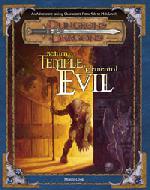
Return to the Temple of Elemental Evil (RttToEE) is a 192-page, perfect-bound, soft-cover book. The cover offers a color illustration by Brom. The interior is black & white, with ink artwork by David Roach depicting locations and possible situations from the adventure. The margins are of average size and the text density is high.
The cartography comes in a separate 16-page color booklet glued into the back of the main book. The cartography appears attractive, though the printing on my copy appeared somewhat blurry.
A Deeper Look
(Warning: The following section contains spoilers for secrets revealed in the adventure.)
The original Temple of Elemental Evil was, according to the history in RttToEE, a result of cultists of Tharizdun convincing the demoness Zuggtmoy that she could gain power through creating a temple dedicated to elemental evil. Iuz became involved, thinking he could use the temple to strike at his enemies. The truth as told by RttToEE is that the princes of elemental evil are servants of Tharizdun, the destructive ancient deity described in various Greyhawk-based adventures. Tharizdun is also secretly the Elder Elemental God that the renegade drow follow in the Against the Giants and Drow trilogies.
In RttToEE, the players must foil the plan of the cultists to uncover the Temple of Elemental Evil and open the gates to each of the four elemental nodes. If this can be done, Tharizdun's servants, the princes of elemental evil, will emerge and use an artifact to release Tharizdun from his prison.
Needless to say, Tharizdun is a really bad Lovecraftian-type world eating entity, and the players really do not want him wandering about.
The adventure itself is sorted into 3 sections and 8 chapters.
The first section deals with the characters' escapades in and around the town of Hommlet (it has grown a bit from the days of the original ToEE, where it was merely a village). The characters receive little direction while in Hommlet, but poking around town will lead them to rumors of strange things going on at the moathouse near the town. There are some cultists of Tharizdun in town, but chances are the party will not discover them until they have investigated the moathouse.
A significant creature has trapped some cultists in the moathouse; said creature could easily be the end of the characters if they are not careful. Once dealing with the major encounter, the party can explore the moathouse and find clues among the belongings of the cultists that more cultists are operating in Hommlet. If the PCs take care of the cultists in town, they may find the clue that they need to lead them to the second part of the adventure.
A final chapter in the first section details the ruined village of Nulb and the Temple of Elemental Evil itself. The Temple is presently inhabited by some hobgoblins and other creatures that the players dispose of if they please, but at this stage the temple and Nulb do not figure prominently in the adventure.
The second section describes the current stronghold of the cult of Tharizdun, the Temple of All Consumption. This is probably the meatiest part of the adventure. The Temple of All Consumption is built in an old volcano crater, thus preventing direct access to its central part. After a brief bit of exploration in a local hamlet, the characters must head into a series of old mines found in the crater rim. Cultists and various other denizens inhabit the mines, and four separate elemental temples are situated throughout.
The mines are situated such that, as the characters penetrate deeper into the mines in either direction, the encounters become more challenging. Though that seems like it will channel the players quite a bit, how this will play out still can take a variety of directions. The four elemental temples compete with one another and are constantly at each others' throats. This will limit the possibilities for players sneaking into the mines; however, once the players learn of the political situation in the mines, they can use it to their advantage.
Once the players discover the secret to getting to the central section of the temple, they may proceed there. By this time they should be able to handle the challenges here. Some of the most powerful priests of Tharizdun, the doomdreamers, fill the Temple of All Consumption's central section, as well as a number of other daunting obstacles. In the end, the PCs may run into a priest who had a change of heart and other clues that will point them back to the Temple of Elemental Evil, where the excavations and rituals that will eventually bring Tharizdun to the world are beginning.
The third part of the temple details the excavated Temple of Elemental Evil. To stop the plans to bring Tharizdun back, the players must confront some of the most powerful followers of Tharizdun, destroy the artifact that allows his return, and/or close the way to the opened fire node.
In addition to the adventure itself, RttToEE includes four appendices. The first list the new magic items and monsters introduced (or reintroduced) in the adventure, including the grell, a favorite monster from the old days of AD&D, and new favorites such as a half-elemental template.
The second appendix provides the details for worshipers of Tharizdun, including special rules for insanity, two new clerical domains (madness and force), and a new prestige class (the doomdreamer). The doomdreamers are highly placed clerics of Tharizdun with powers stemming from their maddening communion with their dark deity.
The third appendix gives all of the statistics for NPCs and special monsters encountered in the adventure.
The last appendix offers two player handouts. The handouts are clues that the players find along the way, memoirs that reveal important details about the cult's plans.
Summary
Stuffed with a huge variety of encounters, RttToEE should keep the players busy for months. The adventure purports to run the characters through a major portion of their careers, from 4th to 14th level--which it should do easily.
Furthermore, the material is well written and consistent with the D&D rules. This should not be a surprise, given that the author is one of the lead designers of the 3e system.
I do not, however, consider this to be Monte Cook's best adventure by a long shot. His two campaign-style adventures for the Planescape setting, Dead Gods and Tales of the Infinite Staircase, are just as epic in scope but present a far greater variety and creativity in the types of challenges that the adventurers face. For the most part, RttToEE involves mostly a series of interconnected dungeon crawls.
As I read the crater-rim mines, I was reminded of the second book of another campaign-style adventure, The Night Below. The Night Below is similar to RttToEE in that the players face an evolving plot with which they must grapple; yet the second book includes many combat encounters that the players must plow through to reach their objective--proving, in the end, very tedious. I worry that the crater-rim mines could turn out the same way.
Another problem I noted is that, in the initial section, the players' motivations are weak and the trail of clues is quite tenuous. The adventure could use some suggestions for firmer PC motivations and more information to clue the players into what is going on in Hommlet. If the players miss the diaries of the priest in the moathouse, the whole adventure could pass them by.
Still, the adventure isn't bad for all this--it is still an immense adventure with tons of usable material, with a sort of brooding Masks of Nyarlothotep feel to it. It just isn't up to what I have come to expect from Monte Cook's mega-adventures.
Ratings
Ready to use material - 5. Outstanding. New creatures, new magic items, spells, domains, and prestige classes. Full-color maps with good keys. A large variety of solid and creative NPCs and other encounters.
Idea content - 3. Though there are a few gems, overall I felt that the dungeon crawl feel was a little overbearing, that the players were funneled in places, and that the crater-rim mines could easily become a tedious stream of encounters.
Value for money - 4. Though it comes at a pretty penny, this thing is stuffed.
Overall substance rating - 4.
Overall style rating - 4.
How I rate D20 System adventures (standard blurb)
As far as I am concerned, canned adventures provide two primary points of value: ideas (adventure premises, interesting challenges, etc.) and ready-to-run game material (maps, useful and properly done encounter statistics, new creatures and items). The obvious third criterion is overall value for money, which includes page count for a given cost and use of space.
I use these three factors to determine holistically what "substance" rating I'll give the item on RPGnet. This is separate from the style consideration, which I use as stated on RPGnet.
-Alan D. Kohler
editing by Mike Johnstone

