

 Search
Review Editing
Review of The Sunless Citadel
 Goto [ Index ] |
I have always thought that low-level modules were the hardest to write. There aren't that many creatures that a first-level party can successfully battle, and using the same old goblins time after time becomes boring fairly quickly. The complexity of the module also suffers, because 1st level characters do not have much margin for error. If they screw up badly or get lost, they may never recover.
Bruce R. Cordell has taken up the challenge with The Sunless Citadel, the first official WOTC module for D&D. It is the first of the Adventure Path modules, a series of eight modules to take characters from 1st to 20th level. That means this adventure is designed for beginning characters, fresh out of the PHB.
Yes, this is a dungeon crawl. But it is a dungeon crawl with a number of interesting elements. It also has a fairly standard cast of characters up until the end, but does show off the nicer aspects of the new system.
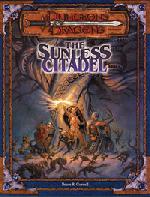
Let's begin with the art. The cover picture by Todd Lockwood is pretty good and does correlate well with the adventure. In fact, I think it correlates a little too well - players know more about the module than they should just by looking at the cover. The interior has art by Dennis Cramer that is also good, and the small illustrations throughout can easily be shown to players to heighten the experience.
The cartography is also good inside, with all the maps on the front and back inside covers. It is nice to have them showing the different types of doors on the map (stone versus wood), and trap locations. Todd Gamble did a good job on these.
The writing style of the module is clear and concise. Descriptions are detailed and the new headers for traps and monsters are clear and easy to refer to. The module is packed with information, and they moved all the monster stats to an appendix, I believe, to give more room for the main text.
After this point I will begin a more detailed analysis of the module, which will contain spoilers. You are duly warned.
Spoilers
This module seems to be slightly conflicted. On the one hand, there is clearly pressure with the new edition to bring D&D back to the dungeon. Hence this first module takes place in the dungeon. There also seems to be pressure to get back somewhat to a more first edition style with lots of traps, puzzles and monsters jammed together in a dungeon. Bruce Cordell has written all these elements in. On the other hand, he clearly is not content to do a pure Gygax dungeon. He has a number of interesting elements, like a newborn dragon kept as a pet and deranged underground druids. The tree growing deep in the bowels of the earth is a great idea, and seems largely drawn from folklore of large oak trees as centers of evil power.
Let's start with the good aspects of this module. It is very clear and provides sidebars to help the DM run the interplay between the various denizens of the citadel and the PCs. There is a lot of opportunity to use various skills, including using Diplomacy to mediate with the kobolds and possibly the goblins. The secret crypt with the transformed troll is a great touch, and it is always nice to see an encounter in a dungeon that frankly outclasses the PCs and forces them to run. Having this in a first level module should rightly teach the PCs the value of caution.
The atmosphere of the module is also good. The riddle of the disappearing saplings seems to at first have a simple answer: the goblins are stealing them. Once it becomes clear that the goblins have not taken them, it is up to the PCs to penetrate to the grove level and destroy the twig blights. All of the added elements of the failed dragon cult, mixed with the live tiny dragon, add a lot to the standard dungeon romp. The evil tree growing in the depths of the earth is also easily sufficiently creepy to help the adventure along, and the unusual final antagonist is imaginative.
I also especially like the way the effects of the tree can linger on even after it is destroyed by the PCs in the form of reproducing twig blights. The options in the town of Oakenhurst after the adventure are also good.
Make no mistake, this is a very good module by D&D's standards and should sufficiently challenge the PCs. Mr. Cordell has obviously put some effort into improving the standard dungeon crawl and it shows. Unfortunately, he has not been completely successful. The problems in the module are the same ones we always see in D&D modules.
First off, the balance of power between the goblins and kobolds is not credible. The kobolds have 19 warriors and one 3rd-level sorcerer. The goblins have 14 goblins, 6 hobgoblins, a 1st-level cleric, a 2-HD hobgoblin, a very powerful bugbear, two dire rats, and a tiny dragon, and that isn't even counting the additional goblins and bugbears who live on the level below, along with their master, the Outcast. The goblinoids clearly outclass the kobolds and could destroy them with fairly light casualties if they wished. Why they do not is not clear. They clearly fight determined battles, as shown by their capture of the dragon. In addition, the goblins clearly can leave the citadel any time they want to sell their fruit to the village.
Why would this situation exist? The only reason I can see is to provide a manageable threat to the PCs when they are first level. The PCs are obviously meant to go through the kobolds one way or another first, then tackle the goblins when they are more powerful and more experienced. This is a real pity, because one could have easily designed the module differently by getting rid of the kobold entirely and setting up hostile factions in the goblins, some who wish to follow the Outcast and some who do not.
In addition, there are the standard dungeon problems beyond the illogical jumble of creatures. How do these kobolds and goblins eat? Where do they get their water? Do they live off rats and wells only? The text seems to suggest that they eat each other, but that clearly isn't sustainable. If the Outcast feeds the goblins with his underground gardens, how did they eat before, and how are the kobolds getting sustenance? If the kobolds get food from the surface, why is there no chance to meet them up there?
A lot of people reading this review might think these concerns are pointless for gold old XP-slaying and gold-gathering. And they would be right. But many people don't play D&D that way, and as a generic, universal module, the Sunless Citadel should accomodate as many different styles of play as possible.
In fact, the fixes aren't even that hard. All one has to do is introduce a subterranean river or a couple of wells. In fact, one expects them, simply because the tree and crops have to grow on something. The module is good on the effects of heat and geology on the the grove level - it would not have taken much effort to introduce water into the caverns. As for food, all it takes is a couple of sentences about how the Outcast took over the lower level and has produced bumper crops of food for the goblins. The kobolds could have a farm above-ground or a large fungus and rothe room in an area of the dungeon.
The other nice thing about adding these is that they open up additional role-playing opportunities. The PCs might not have to face their adversaries head on. They could burn crops or drive off animals and force the surrender of their enemies that way. In fact, that is arguably more humane than slaughtering them all to a man, which is the option that seems to be endorsed here, at least in part.
The ultimate problem here is the same as in most other dungeon crawls. The placement of monsters is illogical and extremely unrealistic and forces play into a kick down the door style of play, because many of the elements that would lead to a more realistic situation and more role-playing are left out. That is a shame, in my opinion.
Summing Up
The Sunless Citadel is a good starting adventure that will teach new players a lot of the elements of the game and give old hands something interesting to play. The plot (for a dungeon crawl) is fairly involved and leads easily to future adventures. In addition, the adventure is clear and well-put-together and shows off the new system's advantadges well. On the other hand, the adventure suffers from many of the same old problems of dungeon crawls and thus unnaturally crimps role-playing and logic in favor of tactics and slaughter.
This module is good and worth getting, and with some simple fixes can be made to be outstanding. I look forward to more efforts from Bruce Cordell, and hope he continues to stretch his abilities to improve the standard dungeon crawl.
Style: 4 (Classy and well done)Substance: 4 (Meaty)

