

 Search
Review Editing
Review of Elfquest
 Goto [ Index ] |
Introduction:
Bias Alert: I am an ElfQuest fan. I've got the comics, the graphic novels and the calendar(s). The limited edition poster is on my wall. So, buying the role-playing game was a natural thing. That said, this will be not a fan-girl review (I hope). I've run several ElfQuest campaigns, so I have a little experience behind the screen.
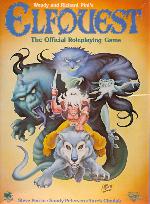
ElfQuest: the Official Roleplaying Game boxed set is an adaptation of ElfQuest, a black and white quarterly comic that began in the late 70s and continued until 1984 by WaRP Graphics (Wendy and Richard Pini). The original 21 issues are something of a cult classic. The story was reprinted in Marvel comics and new series, including Seige at Blue Mountain, Kings of the Broken Wheel, New Blood, Wavedancers, Hidden Years and Shards, all followed until the titles were reunited under the ElfQuest banner once again. The series was discontinued in the late 90s, but WaRP Graphics continues to publish Readers Collections.
The role-playing game was published in 1984. Because of writing and production times, the rules are based only on the first 18 issues of the series, leaving a few things out. This was corrected in the ElfQuest Companion, published in 1985. When Chaosium re-released the game as a single trade paperback, the Companion was included in the book (along with the extra bits from the boxed set), adding to the overall value.
What You Get:
In the original boxed set are the ElfBook and the WorldBook, a parchment map of the World of Two Moons, fifteen character sheets, a booklet containing errata, reference sheets and example of play, and the complimentary 80s dice – 3d6 and 2d20s (which act as d10s with the numbers repeated twice).
Book Layout/Artwork:
Well, being a fan of the comic series, I was delighted with the art, as it is drawn entirely from the original series. Plus, their use is more than decorative – often they are used to support game play examples, informative and friendly to new GMs. Wendy Pini's style is powerful and the inclusion of her artwork puts you in the right frame of mind to play the game. Illustrated mini-character sheets for several of the main characters also appear in the books. Artwork aside, the layout of the books is very straightforward and cleanly done, with few (if any) typos. While there is no index (grrrr), each page has on its edge corner a chapter heading, so it's hard to get lost. You won't be buried in these rules – they follow logically. The Elfbook is divided into Forward, Introduction, The World of ElfQuest, Creating an Elf, Game System, Skills, Magic, Combat and Hunting, Other Tribes and Folk while the Worldbook is divided into Introduction, Hazardous World, Flora and Fauna, three game scenarios and a glossary.
The Game:
ElfBook
After the obligatory general introduction to role-playing, readers are thrust into the game world by a run down of the basic tenants of ElfQuest and a summary of the first 18 issues. The setting is a Neolithic earth-like planet in which a race of space-faring and shape-shifting beings crash lands and become the elves of later human myths. The World of Two Moons is a brutal one, where the elves magic is unpredictable and weak. Humans fear the elves and delight in their extermination. This forces those surviving elves to fragment and retreat to survive in such a harsh, bleak world. The main story focuses on the tale of a tribe of elves, the Wolfriders, who set out to reunify a scattered people and reclaim their celestial heritage. While not exhaustive, the game's summary is an excellent treatment of the story.
ElfQuest is based off of Chaosian's standard RPG system, the most well known being Call of Cthulhu. Those familiar with CoC, or any of Chaosium's games, with find it a relatively painless transition to the ElfQuest mechanics. Attributes are as follows: Strength (STR), Dexterity (DEX), Size (SIZ), Constitution (CON), Intelligence (INT), Appearance (APP) and Power (POW). These are rolled randomly (personal icky for me but you can always fudge and let players assign their rolls once done) on a variety of d6 combinations, determined by the elf culture you choose. For example, a Wolfrider will roll 2d6+6 for CON, a Sun Folk Villager 2d6+5, a Glider 2d6+4 and a Go-Back 2d6+7. The normal starting tribe is Wolfrider, depending on your campaign, so stats for generating elves from this tribe are included in the chapter. Other tribes (and species) are included in the last chapter of the book, alongside brief but adequate cultural descriptions. Secondary stats, like hit points (your SIZ and CON averaged), magic points (your POW), base skill percentages, height and weight are derived from the basic attributes. Age is determined randomly, and affects both the total number of skill points you have to assign to your skills, which are percentile-based, and whether or not your character has "recognized", a.k.a., finding your soul mate. Once you have your skill points, you can allot them as you see fit, whether that means making your elf the most proficient huntress in the band, cautious herbalist or anything in-between. There are no classes and no levels – skills are raised through in-game use or training.
Next is the game system, a series of elegant mechanics that flow pretty smoothly and intuitively. You roll your skill (or your default, based on your attribute) in any situation. If you roll under the skill's percentage value, you succeed. Roll really low and enjoy a special or critical success; roll really high and you will fumble. Charts indicating unusual results are provided both in the book and in the reference sheets. As you play the game and use a skill successfully, it's checked off and at the end of the session a roll is made to see if you increase in skill. If you roll higher than your skill, you get to roll to see how much you improved – simple as that. This system reflects how easy it is to learn the basics of a skill and how hard it is to progress further once you have a high proficiency. You can also train those skills under the tutelage of a more proficient PC or NPC. A detailed skill list follows this section as well as the magic section, detailing how it works and what powers are available, although magic is less magical and more psionic in nature.
Combat is handled a little differently in ElfQuest than it is in Call of Cthulhu, because of the nature of ElfQuest. These cutesy elves fight. A lot. But it's all in context. As such, combat is modified to replicate different kinds of weapons and physical ability, giving rise to the Strike Rank. Your character's strike rank determines combat order and is calculated by a character's Strength, Dexterity, and the strike rank of their weapon. The better your attributes and the faster your weapon, the lower your strike rank will be. The math is done before hand and written on the sheet, so no struggling to come up with numbers during play. Combat begins with the character with the lowest strike rank, followed by the next lowest, and so on until all have attacked. Damage is determined by weapon. The short sword does 1d6+1, for example. Because elves have a finite (and small) pool of hit points, combat is fairly lethal. Hit locations add for added depth and realism. Like the series itself, elves can and do die.
Worldbook And there are lots of things to kill them! After a Gamemaster's introduction, the Worldbook discusses all the nasty ways the world can hurt a hapless elf, hence the chapter title, "Hazardous World." A complete selection of world flora and fauna comes next, with special attention paid to wolves, one of the more prominent species in the stories, but you will also find descriptions for some fantasy creatures; no dragons here, but you will find giant birds, dinosaur-like shell-backs, and semi-intelligent strangleweed plants. Last but not least is the inclusion of three scenarios to use with your players. Two of the scenarios are adaptations from the original story material; one where the elves must rescue a tribe member from a dire fate at the hands of the humans and another where they must defend the holt from a creature spawned from long-forgotten elfin magic. The last one is an original scenario, where a mad, aged elf warps a woodland copse into his spidery abode. A fairly complete ElfQuest glossary completes the volume.
Included Accessories
An RPG that includes copious character sheets, errata, quick reference tables and examples of play always wins brownie points with me, so I was very pleased at their inclusion in the boxed set. These are also included in the second, trade paperback printing. The map is a parchment colored and hand drawn by Wendi Pini herself. All the locals of the series are mapped out and artwork from the series decorates the border. The character sheets are a great help and if you use them all up, there is another printed on the inside cover of the Elfbook.
The Supplements:
What's a game without supplements, right? There are only three supplements to the game, which is impressive considering the small market for it (kudos to Chaosium here), so I've included mini-reviews on each to be thorough.
ElfQuest Companion
Out of all the supplements published for the game, this is the book to make sure you have. As said earlier, this book was included with the second edition. You can certainly play the game without it, but it has lots of nice stuff to play with, specifically; a series of random tables for character creation, including everything from eye color to scars to clothing material. Even if you don't want to go random, you can use this as an inspiration guide. There are several excellent essays on how the ElfQuest role-playing experience is different from other games, which may be helpful to the player not accustomed to the comics. Also included is Wolfhaven Holt, an elf tribe based on a splinter tribe of Wolfriders. This is followed up by two more adventures, one for Wolfriders, one for Plainsrunners. The Companion includes more of the sumptuous artwork of the comic series and mini-characters for the rest of the main story characters.
Sea Elves
This supplement details a non-series elf tribe called, surprisingly enough, Sea Elves (though later, there would be two comics featuring two different Sea Elf tribes). It takes the barebones supplied in the main rulebook and builds an entire aquatic culture for players. Three scenarios complete the book; one details an entire Sea Elf community that the Gamemaster can use to base a campaign on.
Elf War
The last of the published supplements, Elf War is split into two sections. The first half, Beyond the Frozen Mountains, is reserved for detailing an alternative northern culture (though, in reality, it is very similar to the Go-Back tribe), the northern world (handy if you are running Go-Back scenarios) and a brief scenario. The second half, Elf War, details the events of two tribes fighting each other as a result of an untimely love affair. Most handy, however, is the last page, which details alternate rules that simplify combat in the game. Most are simple enough that the Gamemaster likely would have thought of them already, such as dropping strike ranks altogether in favor of letting dexterity determine attack order. Great to get if you want a complete set of books, but certainly not a must have. A small side note: If you really want to stick to as close to cannon as humanly (elfinly?) possible, grab yourself a copy of the Wolfrider's Guide to ElfQuest, a non-game book designed for readers that contains a complete (as of printing) timeline, huge glossary, character list, and more.
The Pitfalls:
The box suggests a few play styles, such as recreating the original tales playing the characters from the series. The mini-characters make this possible, but I wouldn't recommend it. Players new to ElfQuest may not understand the story arc and players familiar with the story likely don't want to replay it, unless you, as the Gamemaster, want to completely change the story. Part of the potential fun of ElfQuest is creating new tribes and new lands to adapt the stories to. What if there was a tribe of elves bonded to mountain lions or who lived among, not separate, from humans?
One of the other pitfalls of the game, though one that can be avoided by the inventive GM, is the tendency to have a campaign digress to nothing more than hunting for your food, recognizing your mate, and having children. ElfQuest has always been about something much grander in scope than day-to-day life. Those parts, unless important to the story, were skipped over in the comic. The Quest was about searching for the larger answers, finding your ancestors, reuniting the lost tribes to reclaim hope for a planet-marooned people. As a GM you need to think in terms of the larger plot arc and where the campaign is heading. Without it, the game won't have the same emotional punch of the series.
Lastly, since the game was released, the ElfQuest comic has changed in leaps and bounds. The elves now inhabit a world where humans have reached a medieval technology level. Some of the stories are set in the future, where humans are an advanced, space-faring race, where magic is more powerful, and where an alien race has made contact. The original game was never intended to handle such things and if you want to take your campaign in that direction, you may find your hands tied. My suggestion – grab your GURPS books and start converting. A copy of GURPS Ice Age, Magic, and Fantasy Races to cook up your species templates, and you can add the higher technology levels, via GURPS Space, at your leisure.
Overall:
If you are an ElfQuest fan, and a role-player, get this game! How can you not have this game already? Copies still exist out there, some on dusty game shop shelves and some in cyberspace auctions. If you are a general fantasy game fan, this game may be worth a look to shake up your perceptions of elves or to add to your collection. As an adaptation of the series, the RPG is exceptionally faithful and well done, but will be of less appeal to non-fans. It's hard to get something like this wrong when the series creators, Wendy and Richard Pini, were part of the development process. My style rating is only three, because the layout is not a color graphic-wowwie presentation we've come to know and love in the 90s and new century, though the inclusion of Wendy Pini's artwork earns many brownie points for me. My substance rating is four, except when talking about the reprinted, single-volume book, in which case my rating is five.
Shade and Sweet Water! - Sun Folk Farewell
Style: 3 (Average)
Substance: 4 (Meaty)

