

 Search
Review Editing
Review of Spacemaster: Privateers
 Goto [ Index ] |
Well the answer to that question is both yes it was and no it wasn't. Spacemaster: Privateers continues in the fashion that ICE adopted with Rolemaster Fantasy Roleplay by providing the complete game in one book with the intention of introducing further detail with forthcoming supplements. This is a radical departure from ICE's previous marketing strategy, where the whole system wasn't contained in any one volume. Anyone who played the Rolemaster Standard System well remember that in order be able play you required not just the Standard System Rules but Arms Law and Spell Law as well.
This all changed when Fantasy Roleplay was released, now the book gave you the Standard System with fewer character races and professions but also provided minimal weapons and spell information so that players could play without reference to other volumes. This is the same with Spacemaster: Privateers. The book provides players with the main gaming rules, an introduction into the Privateers universe, seven character races, eight character professions and an equipment list. Greater detail is promised in the planned release of the support products: Tech Law (three volumes: equipment, vehicles and robotics), Blaster Law (energy weapons), Future Law (more character classes and player options) and the Gamemaster Manual. Three books on the Privateer Universe are also planned. This approach brings ICE into line with what practically all other games companies have been doing for years but for them it's new territory and unfortunately it shows.
The equipment list provided is just that: a list of equipment, costs and weights; no descriptions whatsoever, only a note from the author saying that gamemasters should only use an item of equipment in their games if they are completely sure of what it is. Of course a full treatment of equipment is promised in the forthcoming Tech Law books. This is without doubt the weakest area of the book. Technology is what makes sci-fi different from other genres and Spacemaster: Privateers fails dismally in this vital aspect. I'm sure the author would quote space limitations for this cursory treatment but other games manage and so should this one.
Another minor gripe I have is that the Armour Type classifications are incompatible with the Rolemaster Standard System. This I suppose is inevitable but a real shame because players of Rolemaster will not be able to use the weapon tables given in Arms Law and Arms Law: Firearms. A method of converting this massive resource would have been a nice addition.
The book also contains an introduction to the Privateers universe. This is another area of the book that I didn't like. In fact I would have been far happier with the product if this space had been given over to equipment instead. The Rolemaster line contains no campaign world setting just the rules with settings (previously Shadow World and soon Bladelands) sold as separate products for those that want them. Spacemaster: Privateers would have been better if this format had been followed. The Privateers universe as it stands simply left me cold.
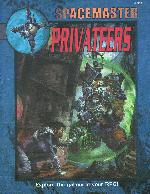
It has an unconvincing (and badly written) background and the alien races simple aren't very alien at all, in fact they're a humanoid versions of common earth animals. The Falanar are sapient humanoid lions (incidentally there is an excellent graphic of a Falanar on the front cover but here it is depicted as a tiger), the Tulgar on the other hand are wolflike and so on. The only alien race that I did like was the insect Xatosians but they do seem to be a straight port over from the Tri-kreen of TSR's excellent Dark Sun setting. A saving grace here is that Spacemaster: Privateers is compatible with normal Rolemaster (except for Armour Types) and so anyone with Talent Law can use it to create balanced aliens of their own.
The vast majority of the book is taken up with the rules. This is a straight port of the Rolemaster Standard System from fantasy to sci-fi. This is the book's greatest strength. All RPGs have to draw a line between realism and playability. Spacemaster (and Rolemaster before it) draw this line as close to realism as possible. This disadvantage of this is that character generation takes a very long time.
This is a skill-based system. All skills are grouped into categories and characters may learn skills individually or in categories (or normally both). Characters take skill ranks in individual skills, each rank improves the skill by a set amount although this amount decreases as you take more and more ranks. The value of any skill is made up of the bonus gained by having skill ranks in that skill to this is added a category bonus, this is made up a category ranks (these are the same as skill ranks but apply to categories) and adjustments from (usually three) applicable stats (the Spacemaster term for attributes). Considering that there are over fifty skills' categories (all of which you have to calculate the bonus for) and each may have from one to about twenty skills in it that is a lot of math! This is made still worse when a character increases in level because his stats are very likely to change and he'll buy new skill and category ranks for his character. This means that the only option is to simply calculate the whole thing again from scratch at every level! If you look around the web for Rolemaster fan websites you'll find numerous downloadable excel spreadsheets purely used to generate Rolemaster characters. In fact every Rolemaster player I know uses one. This is likely to be the case for regular Spacemaster players too.
At this attention to detail in character generation does however have a positive effect on the game which actually move fairly rapidly despite the system's complexity. The combat system for example, is one of the best I've ever used allowing character actions to really influence the outcome, first level characters are more than capable of defeating 10th level opponents with suitable thought and planning by the players.
Combat is however very dangerous and best avoided if possible. While melee combat involves a system of parrying where that attacker gives up some of his attacking skill to increase his defence, resulting in attempts to out think your opponent; ranged fire has no such option and cover is the name of the game here. The system itself is highly customisable. Gamemasters can add and remove skills at will to tailor the system to their own idea of the universe.
I was pleased with the rules for psionics. I had feared that these would be a simple re-naming of the magic rules in Rolemaster. My fears where however unfounded and the psionic rules are new. The necessity of fitting them into the Standard System has meant that they are similar in many ways to the Rolemaster magic system but sufficiently different to merit mentioning.
This game provides no middle ground, you'll either love it or hate it. Personally I love it. If ICE do release the supporting volumes then Spacemaster: Privateer will become one of the most detailed sci-fi games around and my personal favourite, otherwise it will sink into obscurity.
Style: 2 (Needs Work)
Substance: 4 (Meaty)

