

 Search
Review Editing
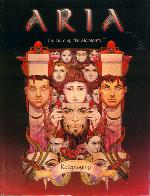
Review of Aria Roleplaying
 Goto [ Index ] |
I have read reviews of Aria before, but never one written by someone who had actually PLAYED the game extensively. Having now GMed an Aria game for two years in a world I created using the Aria-Worlds book, I feel that I am at last qualified to give an opinion based on experience.
This now sadly out-of-print RPG by Last Unicorn Games (before Star Trek) was an attempt to write an intellectual RPG. It is fortunately still available in some gaming stores. There is no setting- just 485 pages of character generation rules, system, and how to build a setting yourself. The system is obviously designed for role-playing in a fantasy setting- with anything from barbarian tribes to Renaissance technology. It can mimic the real world, or it can be used in a high-fantasy setting. This is up to the GM. However, its relevance to modern-day or futuristic settings is very limited.
The game is designed to be played at multiple levels- there are rules for designing and role-playing individual characters, families, or even societies. This is accomplished through the use of different time scales- Mythic, Aria, Narrative, and Action. The first two cover long term developments in a region or society, covering years, decades, or even millennia. The last two are used for the more typical role-playing aspect of the game, and cover campaigns and action. An Aria game can use any or all of these, depending on the desired scope, and there are rules and suggestions for the use of each.
I used the longer time scales to help create the starting setting, but relied on the last two for actual game play. It may have been just my shortcomings as a Game Master, but I found it difficult to instill the same kind of excitement in a game when we were dealing with nations rather than individuals. The development of a world is somehow more intellectual and less emotional than the development of a character, and was something that the players had a harder time getting into.
The Book-
The Aria Roleplaying book is actually two books in one: The Persona Creation book and the Myth Creation book. The pages of these two books are numbered separately, though they share an introduction, table of contents, and index.
The introduction introduces the core game mechanic, the lexicon necessary to understand the terms used in the book, and the different time scales. This core mechanic is rather simple- the system only uses d10s, and only one at a time. The players uses his character's skill modified by relevant attributes (this is constant and therefore doesn't need to be recalculated each time) and subtracts the level of difficulty assigned by the GM. A roll on a D10 of under this adjusted value is a success, and the degree of success on the action is determined by the degree of success on the diceroll. To keep the system open-ended, 1s and 10s can be re-rolled, either adding or subtracting from the degree of success or failure. Slight variations on this game mechanic are used for different situations.
The Aria lexicon is dense and extensive. To me, the redefining of many English words to give them their Aria meanings is excessive and makes the book more difficult to read. You know you are in trouble when half of the words in a sentence in the gaming book are capitalized… The Aria lexicon in the introduction is three pages long, and only covers the tip of the iceberg. Instead of a game master you have a "Mythguide," instead of an NPC you have a "Mythguide Persona," and instead of a campaign you have a "Canticle," to list a few.
Character Creation
Character creation is a long, detailed process. It encompasses the character's entire life, from birth to the start of the campaign. It is point-based, with the number of points being dictated by both the generosity of the GM (the book gives different scales depending on the fantasy level of the game) and the character's age. That's right- age. The age of the character is his most important stat, for the character receives a number of points for character creation per year of life. Therefore, a 20 year old character had only half the number of starting points as a 40 year character. I have found that this encourages players to choose old characters- in my game, there were 2 characters in their 40s, one in his 50s, and one over 60! Very different from games like AD&D, where characters often start in their teens. So now whenever I watch a movie or TV show with my player friends in which an elderly person displays great physical aptitude or heroism, we say- "look! He's an Aria character!" I found that the number of points suggested in very reasonable if not a bit high- players more often had points left over rather than having to cut down skills and attributes to fit within the rules. Even starting Aria characters could probably kick the **** out of just about anyone. Provided that they are old enough.
The character creation section of the book is very poorly organized- with details you need to know to start being located at the end, and essential charts being located far from their accompanying text. Even after 2 years of helping players make characters and designing NPCs, I still get lost in this section. If you plan to use this system to make characters, I suggest using the more streamlined approach available on this webpage: http://www.frontiernet.net/~motto/sotto/aria/. (Under Aria Mechanics- Larry Barry's outline for Character Creation). It takes you through character creation step by step and gives page references to the necessary charts and tables. Otherwise, you will find yourself continually flipping through all 192 pages of character creation rules, searching for that one useful table.
All attributes, skills, and personality traits in Aria are on a scale of 1 to 10, allowing them to all use the same mechanic. There are 18 attributes, from which a player selects the 6 most relevant to the character. These six can be raised, while the other 12 remain at average levels unless purchased down. There are three levels of skills (or expertise, in Aria-speak): talents, aptitudes and disciplines, representing those things which are easy to learn vs. those that require more special training.
This game includes negative and positive backgrounds for characters (or Background Aspects, in Aria-speak). There is a long list of these, and in my experience none are unbalancing. The negative backgrounds often really help add to the plot.
The personality traits available for characters really help bring them to life. They cost no points, but add depth. Any of these personality traits (like Pessimistic, Wise, Treacherous, Tactful, etc.) can be assigned different levels of importance. A low value makes it a trait, a medium-high value makes it a Motivation, and a high value makes it an Obsession. There are also different flavors available for these- they can be apparent (obvious to everyone), suppressed (innate to the character, even though he tries to override them), or concealed (known only to the PC unless something drastic happens). In game play, I found that these personality traits really helped flesh out the characters and remind the players what they were playing, even though I never required any dicerolls related to them. Some of my players liked this system of personality traits so much that they've ported it over to other systems for use in character creation in their own games.
Heritage and Renown are also important parts of Aria, and reflect the degree to which a character is supposed to be a part of his society. But to keep player characters interesting and not just following in their parents' footsteps as seems likely in this kind of game, there are Windows of Opportunity to spend during character creation. These, which are essentially just bonus points to be spent on one particular unique aspect of the character during character creation, are what make Aria characters unlike other people inhabiting their world. They are those experiences in a young character's like that make him who he is. Perhaps a travelling mage took interest in this promising young lad and trained him in the ways of magic. Perhaps he ran away from home to study under a great swordsman. These Windows of Opportunity provide the character with opportunities that would not usually be available to someone of their class or nationality.
In summary, the Aria system of character creation makes very, very detailed characters that fit seemlessly into the game setting designed by the GM. The process is very time consuming, and I lost one player when he realized how much work it was just to make a character. However, in my experience, Aria characters have more depth and flavor than I've seen in characters in any other game. While some good role-players can do all of this on their own, this system forces ALL players to consider all aspects of their character, making it nigh-impossible to make a boring character.
Aria-Mythmaking
The second book in this book details game play. More to the point, it details how the GM should detail game play. This section includes conflict (combat), magic, how to run an "Interactive History," and how to design a setting (including such aspects ad heritage, status, and vocations). The combat system of Aria is the most detailed and complicated system I've ever seen. A description of a brief combat (only two combatants, only a few hits) takes 2 (very dense) pages of description just to detail all of the modifiers and rolls involved. There are pages worth of weapons all have their own modifiers (up to 8 different kinds, I think) depending on their effectiveness against particular defenses. There are long lists of different types of defenses, attacks, and modifiers related to encumbrance, fatigue, shock, etc. After reading through this section and the example 3 or 4 times, I still didn't get it. And I thought that any combat involving this system would take all night. Therefore, I opted not to use it. If you are really, really interested in detailed, realistic combat and don't care how long it takes, this is the game for you. If you can live with a more stylized combat system, or don't want a single combat to take over an entire gaming session, don't use the Aria combat system. Use something else, or play a different game altogether. In my game, I modified the core game mechanic to cover combat as well, and did away with the modifiers and different attack types.
The magic system is also problematic. It is problematic in the sense that it doesn't exist. Instead of a magic system, Aria has a "make your own magic system" system. It does give rules for this, and leaves the rest up to the GM. This provides the opportunity to make a custom-made magic system that fits the overall nature and tone of the game world (also to be designed by the GM). It can be low-fantasy or high-fantasy, it can be based on religion or on "the force," it can mimic alchemy or AD&D spellcasting. However, not every GM has the time to design a magic system.
My biggest problem with Aria is the amount of work a GM is expected to do before game play can even start. He has to create the world, the people, the races, the culture, the history, and even the way reality works. This can be an enjoyable process for a GM who has plenty of times and ideas. It creates very complete worlds, especially if the Aria-Worlds book is used as well. However, the time needed to do this is more than your average GM is going to want to waste (I mean, spend) preparing for a game. In the end, I was left with the feeling that I had written my own gaming system along with my gaming world- who needs Aria if you end up doing all of the work yourself? Aria is more of a set of guidelines for making your own system than a system in itself. But if you already have a world- either from a novel, or a movie, or another game- you may be able to modify it to the Aria rules and thus not have to build a world from scratch.
I love Aria, but it is not a game without faults. It has many. However, it also has many virtues, and should not be overlooked simply because of the poor quality of presentation.
So here are the scores I give it- I felt the need to break them down a bit more:
Character Creation: Substance: 5. Incredible amount of detail. Wonderful for use in any system. Style: 2. You have to put it in order yourself.
Combat: 1. I've never seen a more incomprehensible system. I read this section and laughed, then I discarded it. Definitely in need of a 2nd edition.
RPG book as book for world/system design: 5. Really innovative! RPG book as book to run an RPG: 2 or 3. Requires a very dedicated GM.
System (not combat): 4. It works, minimizes dice-rolling on single tasks, and covers social as well as physical tasks.
Readability: 2. Most sections require several readings before you know what they are talking about.
Style: 2 (Needs Work)
Substance: 5 (Excellent!)

