

 Search
Review Editing
Review of Nobilis
 Goto [ Index ] |
Nobilis is not for everyone.
Despite being fiercely innovative, Nobilis is an RPG of the old style, the sort which requires blood, sweat, and tears to make work. It's a framework, albeit a lush, rich one, and it demands a game master who can fearlessly tear into new ground. It demands players who can support that game master, and who can shoulder a fair amount of the work of creating a world. There is no game on the market I would recommend less to new role players.
But the demands of Nobilis are repayed with a game that is unique among the systems known to this reviewer. Just reading the book is enough to give any GM worth her snuff a half dozen new ideas, and even if playing it ends up being a complete disaster, it will almost assuredly be an interesting and educational disaster.
The Setting
Nobilis is set in a "hidden-world fantasy" genre. That is, the setting is modern and superficially similar to the real world, with the great bulk of humanity ignorant of the mystical forces which play in the background. Much less focussed than the World of Darkness' "urban horror," Nobilis embraces a wide range of myths and fantasies, from light and pleasant children's stories to full on horror of both the psychological and physical nature.
And the boundaries between those extremes are much more fluid than one might expect. One of the basic precepts of the game seems to be that the inhuman world of myths is chaotic and shifting, and nowhere moreso than in matters of morality. Almost everything you can run across is both awesome and terrible, capable of great kindness or horrible depravity in the same breath. This isn't the "shades of grey" morality that is so often claimed by the grittier RPG's, but an out and out amorality reminiscent of some of the more authentic tales of Celtic faeries.
The PC's take the role of Powers, demi-gods who control (or represent, or are) some force or concept of the world. Example "Domains" from the book include scorn, heraldry, calendar days, punk, guilt, and magnetism. The PC's, though they wield incredible personal might, are servants of even greater (and more enigmatic) forces known as Imperators — a useful mechanism which creates a natural concept of the PC group or party, as well as being one way to put some limits on what the Powers can and can not do.
Powers (also known as Nobles) are very diverse in their capabilities and roles. Nobilis has a very loose (and, you guessed it, somewhat difficult to use effectively) system for creating unique abilities for the PC's, and there's never any telling what a given Noble might be capable of.
As if that weren't enough, the eclectic setting embraces a wide (and mostly undetailed) variety of lesser mythical creatures, and, indeed, an entire Mythic World which operates on animistic principles. Nobilis provides a setting into which a clever GM can fit basically anything, and it might well operate nicely as a framework in which a more traditional game could sit.
The System
Nobilis offers a diceless system which is governed by paying for "miracles" (which might be physical feats as well as more traditionally miraculous supernatural abilities) from a limited pool of points — if you run out of Miracle Points, you'll be quite limited until you replenish your supply. The result seems reasonably elegant (though this reviewer has been unable to playtest the game thus far) and definitely quite fast, once one becomes conservent with what the various levels of miracles mean.
Character generation is a typical point-based affair, but with an interesting twist. Disadvantages do not provide any more points in character creation, but, rather, replenish the Miracle Point pools of the characters whenever they rear their heads in play. This mechanic provides a very neat solution to a traditional bane of the point system: minmaxers who want to get disadvantages which will not actually disadvantage them. That doesn't work in Nobilis — if a handicap does not disadvantage you, it also doesn't benefit you.
Character creation also involves the cooperative creation of their Chancel, the headquarters and home base of an Imperator, connected to but seperate from the normal world, and as mundane or exotic as the players desire; and of their Imperator itself. In this manner, the players are pushed a bit further into the role of author, and given some investment in the world that their actions will so impact.
The system makes combat a next-to-useless thing. Yes, it can be done, but why would you bother? With the expenditure of a few points during character creation, a Power can become truly Immortal, unkillable by any force another player might be able to wield. And killing another Power gains you little, as opposed to attacking the things that he loves, or embarrassing him in public, etcetera. Even when being attacked by the Excrucians (the setting's Big Bad Guys), the challenges that Powers will face will almost never be physical in nature.
The ultimate goal of the miracles system is to allow a sort of strange, competetive dance, where awesome powers are employed to subtle effect, and shifting forces brought into array against one's enemies without any third party observer ever even noticing it. How well that works in practice is almost impossible to tell without extensive playtesting, but the very idea is a magnificent one.
The Book
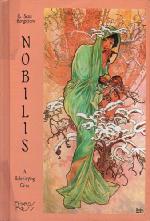
The actual physical Nobilis book is a durable, small hardcover, a bit bigger than a trade paperback, but noticably smaller than a traditional RPG book. It is a shade of pink which will make it somewhat incongruous in any library of RPG's, an effect which was doubtless intentional.
There is little art (only one picture at the beginning of each section heading), and the layout is uninspired. Each segment begins with a wargame-like number-dot-number (example: 2.10.3) signifier, which was a horrible choice that only makes the entire book seem dryer for it.
As if to counteract the influence of the numerical segment headings, almost every segment is prefaced by an (apparantly fictitious) quotation. These short passages do a good job of conveying the odd atmosphere of Nobilis, but after the first few dozen, they get old. This reviewer would have preferred half as many quotes, and a much longer expository piece with advice on how to sucessfully run a game.
Conclusion
Nobilis is a good buy. Even if you never play it, you'll appreciate having read it. Even if you despise the entire concept of hidden world fantasy, the faerie-tale quality of the game makes it fascinating.
However, it's incredibly daunting. With fifteen years of role playing experience behind him, including a good deal of work with other high-powered, diceless games like Amber, this reviewer is still scared at the thought of running Nobilis. It would have benefitted immensely from a much, much longer section of advise on how to GM and play. It may be that the challenge of succesfully running the game may prove too much for it, and that Nobilis will end up in the dustbin of gaming history.
That would be a shame, both because the game and world are absolutely fascinating, and because this game has the potential to help evolve gaming as a whole past its current state.
Style: 4 (Classy and well done)
Substance: 5 (Excellent!)

