

 Search
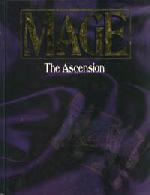
Review of Mage: The Ascension Second Edition
 Goto [ Index ] |
Mage is not that game.
Now, imagine the worst game you've ever even conceived. The setting is banal; the rules are ridiculously hard to use and you spend hours trying to find the damage resolution system.
Mage is not that game, either.
At times, Mage touches on both of these extremes. The setting is one of those that simply grips you to use it; the character creation is easy, fun, and is perhaps the best system for giving a character a personality that I have ever seen. On the other hand, the task resolution can be Byzantine and simply annoying at times and the rules leave much to be desired.
THE SETTING
Guess what: reality's not what you thought it was.
"Well, duh," I can hear you saying, "That's creative."
No, seriously now. Because this is more than just a "they lurk among us" tale. They lurk among us, sure -- but there's a twist.
First, "they" are really "us." The hidden folk in this game are, as you might expect, the mages. Unlike some other games, mages are human: they think like humans do, they act like humans do, and they sympathize with humans. Every mage became the way they are by becoming suddenly Awakened. In keeping with Mage's major theme of subjective reality, every Awakening is different, but every Mage starts out as an unknowing "Sleeper" until he receives an epiphany.
Second, they're doing more than just lurk. Mages, by nature, alter the very fabric of reality. They don't just call down fireballs on anything marked "target." Instead, they alter perceptions of truth and the possible around the world, as well as controlling probability, coincidence, and the forces that make up the universe. Magic (or, as Mage pretentiously calls it, "magick") is categorized into nine Spheres. Mages with even a passing familiarity of a given Sphere can have superhuman perceptive abilities; mages with some amount of skill can alter reality to their advantage with some ease.
But don't go pulling down the moon or leaping tall buildings in a single bound just yet. Reality doesn't like to be altered.
Sure, reality is subjective. Reality can be altered by a strong will. The Sleepers don't know that, and yet they still have their influence. The dominant mental paradigm is that the moon orbits the earth in regular, predictable patterns, and that jumping over a building is totally impossible. Sometimes, when you bend reality too far, it bends back.
"Vulgar" magic, as impossible effects are termed, lead to "Paradox," a situation in which the fabric of the universe retaliates for causality violations. Performing vulgar magic can lead to Paradox, which is even further increased when the mage is being observed by Sleepers or botches a spell. Needless to say, Paradox is definitely not a good thing.
For this reason, most mages rely heavily on "coincidental" magic. Instead of a mage running at superhuman speeds, crowds just happen to part in front of him. His car engine, thought to be broken, starts running again once he gives it a good kick. That bullet hole was "just a flesh wound." He happens to have that bottle of epoxy on him: "Just lucky, I guess."
This, I feel, is a brilliant magic concept. Mages have to be inventive – no more solving every problem with that Explosive Fireball. They also have to be discreet, unless they really love getting roasted to a crisp or driven mad by Paradox backlash. Sure, once in a while they can cut loose with a neat spell, but they better not do it too often, and they'll only be vulgar when it's *important*.
So, that's how reality works. What else did they add?
An awful lot of stuff; some useful, some not.
First, the spirit world. There are an awful lot of "mystick" (there's that "k" again) realms that Sleepers don't know about. There's the Near Umbra, the Penumbra, the Mirror Zone, the Middle Umbra, the Digital Web, the High Umbra, the Realm of Dreams, the low Umbra, the Horizon Realms, the Umbral Domains, the Shard Realms, the Umbral Realms, the Paradox Realms, and the Umbrood Realms. Are you Umbra'd out yet? I know I sure am. I'm not really sure why the creators felt they had to include a whole bunch of wacky spirit dimensions; I think it adds more pressing realism to focus on Earth rather than some extradimensional "Umbra" variant. (Does an Umbrarella ward off spirit raindrops? Thank you folks, I'll be here all night!)
The next element of magehood (mageliness? Magism? Magosity?) is the Path. This is where the Ascension part of the title comes in. Ascension is a mystical, poorly understood thing. All that is known is that to Ascend, a mage must pay close attention to his Avatar. Avatars are mystical, poorly understood things. Got that?
There are many theories given of what the Avatars are. To quote the book, an Avatar is "the magickal (sic) consciousness that allows a willworker to do her thing." Anyways, the Avatars force the mages to go through Seekings: trials by fire in which the mage has to advance his self-knowledge to proceed further down his Path.
Finally, the book lists the main groups and their views of how magic works. The nine quasi-allied Traditions are probably where the majority of PCs will come from. These range from the very interesting Euthanatos to the conventional Order of Hermes to the Sons of Ether who perform magic through their creative True Science and the Virtual Adepts who use computers, networks, and the Digital Web to manipulate reality.
Unfortunately, some of the Traditions are fairly worthless. The Cult of Ecstasy in particular is a group of drug-using, sex-obsessed, irresponsible losers who are "perpetually stoned", to quote the source material. I can't understand how such short sighted behavior can lead to Ascension, but perhaps society has trained me overmuch as a Sleeper. In any case, I would not allow Cultists into my game. Also questionable are the Verbena and the Hollow Ones, who I will discuss further under Attitude.
Besides the traditions, there are three major groups. There are the Marauders, who are essentially mages that manifest primal chaos. There are the Nephandi, who are the mandatory Dark Old One-worshipping cultists.
Finally, the Technocracy is the group that is currently in power. They believe in the importance of the many over the few, the value of harmony and stability, and they believe strongly in defending the mass of humanity against supernatural threats such as the vampires, werewolves, Nephandi, or the Tradition mages. It is due to the Technocracy that the scientific and skeptical viewpoint is so prevalent today. Although the book portrays the Technocracy (rather unfairly) as a bunch of goose-stepping clones out to suppress Creativity and Goodness and Light, any GM worth his salt could easily bring out the philosophical and moral viewpoints of the Technomancers and create some valid ethical dilemmas for the players.
Overall Setting: A- Some brilliant concepts. The book makes me want to drop whatever I'm doing and GM it. A few blemishes in the Spirit Realms and the Traditions lower the score.
THE SYSTEM
First, the character generation system is entertaining and gives a good grip on how a character thinks and acts. The system is non-random and essentially point-determined. Each characteristic is rated by a number of dots. Although this looks kinda cool on paper, I did wonder why numerals were not used instead. (Possibly to make the system look different from competing systems?)
Characters have nine Attributes that players may arrange: three each of Physical, Mental, and Social.
Character then have Abilities: Talents, Knowledges, and Skills to assign dots to. The divisions are somewhat questionable, but it works. The number of abilities is at the level where many skills can be covered by one Ability rating: for example, Brawl rather than the GURPS equivalents Karate, Judo, Brawling, and a host of maneuvers. This, of course, decreases the resolution of the skill system, but I find that I enjoy it.
One side note is that any trait with 4 or more dots has a Specialty. The player chooses something that the character is especially good at, and the character gets a small bonus when that situation comes up. I like how this differentiates between two highly skilled characters. I have only one question: why can't characters have specializations at every level? Characters than pick Backgrounds (sort of like Advantages from GURPS), their levels in Spheres, and their Willpower and Arete (basically a magic attribute). A nice touch is that mages can spend their Willpower to give them extra success or cancel out a botched spell – altering reality through sheer force of will.
What I found most interesting, however, was the Traits and the Personality Archetypes. These give a good handle on how the character acts and thinks. What is truly cool is that the Personality Archetype gives the character a way to regain Willpower when the player acts in character. This is a nice example of the system backing up the setting and encouraging good roleplaying.
I was not as happy about the task-resolution system.
The basic die mechanic struck me as odd. A character adds the dots for a related Attribute and Ability and considers them as ten-sided dice. The player then rolls the dice against a difficulty number set by the GM. Dice at least as large as the target number count as successes and the player must often have a certain number of successes.
I found that this double requirement of number of successes and target number was a big nuisance, and it was very hard to intuit the difficulty of a task from the target number and number of successes required. Perhaps the system would become easier with practice, but I doubt it. There was only a very rudimentary guide to assigning target numbers ("3: Easy 6: Standard 8: Difficult") and no guide at all for required number of successes.
It only got worse from there. Numerous references were made to splitting up your dice when you want to make two actions on a single turn. That's all well and good, but what if you want to make two actions using different skills? Which skill dictates how many dice you use? This was never explained to my satisfaction, even after half an hour of scouring the book.
The resolution system was...ok...when applied to magic. "How about combat?" I hear you ask. Well, you really shouldn't have. There are two kinds of damage: normal and "aggravated." Aggravated damage was first explained somewhere around page 80 with the enlightening comment that characters can't "soak" aggravated damage. Okay...whatever. The phrase "soak" was used numerous times throughout the book. After I had finished reading it, I realized I still didn't know what the term meant. I looked back, and found it was defined in one sentence in small type at the bottom of page 257.
The rest of the combat rules were no better; annoying fiddly changes to Difficulty numbers and successes required and a general assumption that the reader already knew the combat system. As far as I can tell, it would take upwards of five rolls to resolve one attack, each roll consisting of around seven ten-sided dice. No real example of combat is given except for a brief example of one roll during a pseudo-comic book in the back that is a real waste of six pages that could have been used on real examples.
Overall System: C- The character generation was nice, but I was left unsure how to do anything with the characters. Were I the GM, I think I would leave the character generation system as it stands, and go diceless, emphasizing the fate vs. free will dichotomy and running a no to very low combat campaign. I believe a GURPS version of Mage: The Ascension exists; this may be another alternative.
THE ATTITUDE
First off, the occasional pretentiousness and overblown self-importance irritated me, especially the extra "k" in "magick" and "mystick." I swear, some day a game designer is going to include the term "mahjjikxk" just because "magic" is too overused. Fortunately, this really only is a problem in the first few chapters, where I actually believed that it was a parody at first.
Unfortunately, the use of Excessive Capitalization prevailed throughout the book. This is another trend that I would like to see Taken Out and Shot.
And now, on to "darkness." The introduction says that Mage is a "dark modern fantasy" in which "hopelessness poisons the very earth." Sorry, but "hopelessness poisoning the very earth" just isn't for me, and I'm not partial to the "I'm real cool 'cause I wear all black, thick white makeup, and pierce my bodily extremities" school of thought either. The whole "Gothic-Punk" thing is a major turnoff to me.
The game designers occasionally disagree. The group called the Hollow Ones is full of the giving-up-on-life and general blackness that I mention above, and the designers insert hints that the Hollow Ones are destined to become the Tenth Tradition and lead the world to Ascension...
You may disagree entirely with my point of view. Good for you; go for it. For the rest of us, there is thankfully a page-long section on alternate moods. This section is, for me, a godsend. I feel the whole game would play much better without the "I'm cool 'cuz I'm dark" attitude, so it's great for me that's it's easily avoidable.
Speaking of which, there are some very nice sections on game mastering, storytelling, and creating mood and atmosphere. I appreciate them.
Overall Attitude: B+ The default "dark" is thankfully understated, and can be easily eliminated. The GM advice is very good. "Magick" is a minor nuisance at most.
THE ART
Overall Art: B The in-chapter art is pretty good. The pictures of the Traditions are very nicely detailed and give you a good idea of the Tradition's background, although the Hollow Ones art is ugly. (Maybe that gives you a good idea of their background, on the other hand.) On the downside, the intra-chapter art that starts each section is frankly hideous. I sure hope they didn't pay anyone to do those unattractively distorted collages. And the weird stuff behind the bad fiction in the front of the book is a big waste of 16 color pages.
The Final Grade A- Use the setting. Don't use the system. Modify the attitude. Get philosophical, get in character, change reality, and make a difference in the lives of the Sleepers on Earth.
Have fun.
P.S. I'm a little uncertain as to how "Style" and "Substance" factor in. Consider "Substance" to be an amalgam of system and constructive GM advice and "Style" to be the coolness of the setting. See above for art info.
Style: 5 (Excellent!)
Substance: 3 (Average)

