

 Search
Review Editing
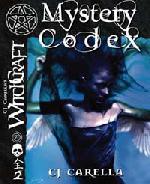
Review of Mystery Codex
 Goto [ Index ] |
I picked up the Mystery Codex because I will be playtesting future WitchCraft products and I wanted to have all of the material that I could, as well as the up-to-date rules. Eden Studios offered to send me the second edition rule book for free if I bought the Mystery Codex and that sounded like a pretty sweet deal to me. After buying the Mystery Codex and reading it, I have to say that I am not disappointed. WitchCraft, while not my favorite game, is definitely a fun and interesting setting.
Introduction
At the beginning of the book, Eden Studios takes a moment of time to clearly state the text and rules conventions they use and to explain the situation with the changing of companies from Myrmidion Press to Eden Studios, and their plans with the line.
Rules
This chapter has mainly new character rules, from new concepts and skills to the revisions from the first edition. Many of the skills and Qualities and Drawbacks from the first edition were changed slightly, and those modifications are included here. There are also some more combat rules, with more detailed martial arts rules as well, as well as a comprehensive experience chart. This is a much-needed addition to the first edition rules, which were unclear and sometimes actually missing references.
There are also a few new Covenants described. The Fellowship of Judas is composed of members who are deeply concerned about atoning for sins they have committed, and a number of them are undead. The House of Thanatos is a primarily necromantic organization with a large number of undead members. The Pariahs are the largest group of Disciples of the Flesh, abused people who gain powers over their bodies. The Storm Dragons are a primarily Eastern Covenant (although they have spread through the western world) that practice the arts of Tao-Chi. All of the Covenants are actually pretty interesting, and again, the Mystery Codex stresses that these are not the only Covenants of their type, just examples of the more prominent and well know organizations.
Inhumans
This chapter is devoted entirely to providing rules for people who want to play a type of spirit or undead. The examples given are ghosts, phantasms, vampires and the relentless dead. The rules are solid enough and seem to work okay, but they are not always 100% clear and can be very unbalancing in a chronicle if used unwisely.
Ghosts are the spirits of those who have died and remained behind, while phantasms have slightly different powers, and are more powerful. The rules on spirits are somewhat unclear, especially those on spirit evolution, but they can be puzzled out with some time. Hopefully they will be cleared up in future supplements and printings. The rules for vampires are interesting and have potential, although the creation of vampires seems to wanton and hap-hazard to taste completely wonderful. The relentless dead could work nicely for a short game, but are damned powerful and focused for most long-term chronicles.
Associations
This chapter goes into more detail on the new Covenants, giving brief histories, information on organization and philosophies. Each Covenant manages to have some kernel of an idea that is interesting, like the Fellowship of Judas, a Covenant filled with those who want to atone for their sins, yet the entire organization manages to not fall into some useless collection of regretful rejects wallowing in their self-pity. Likewise, the Storm Dragons, while not written up in exceeding detail, do manage to avoid the trap of being "Mystic and enlightened Asian dudes who abhor combat but can whup-ass when they need to" like many martial art groups in role-playing games. I hope that such a trend of interesting Covenants continues in later supplements. So far I have found something I like and something I cannot stand (from an in-setting viewpoint) for each Covenant, and I like that. It keeps me from simply falling into one group.
Metaphysics
This chapter has the new revised magic rules (which include the official abandoning of the Essence Control Table) as well as a slew of new abilities and powers. In addition to the new rules (which are simpler, doing away with many of the modifiers and die rolls from the first edition), there are new invocations and necromantic powers, as well as two entire new arts, the Disciplines of the Flesh and Tao-chi.
The new invocations are not only lesser invocations (some new ones include Hideaway and Locate) but also greater invocations, spells of such magnitude and complication that they require an immense amount of skill and study. Things like Bilocation and raising the dead are greater invocations. Each greater invocation has at least one prerequisite, and you cannot raise your skill in the greater invocation about those of the prerequisites. A simple and easy system that I like a great deal. The new necromantic powers are powers for the same paths but beyond level 5, including effects like more powerful spirit summonings or controlled and forced "re-incarnation" of a sort.
The Disciplines of the Flesh are an odd ability that arises from the pain and anguish of the users, their anger and their magical potential enables them to reshape their bodies and warp their limbs as they desire, reminiscent of Vicissitude from Vampire: the Masquerade. The Discipline is much less versatile, however, although it is powerful. Tao-chi is the art of channeling your chi (Essence) through your limbs to perform great feats of martial prowess, from amazing unarmed strikes to enhanced speed.
Supernatural
This chapter goes through a quick tour of the Otherworlds and several new monsters, from spirits to ferals, shapeshifters.
One of my favorite aspects of WitchCraft (and one that I actually became aware of through Armageddon) is the division of the Otherworld according to the kabbalistic Tree of Life, with each Sephiroth being a different location in the spirit worlds. A quick description of some of the major Sephira are given and a closer look at Geburah, the Sephiroth of the Dead, finishes the section on the spirit worlds. There is a lot of potential here, if developed well, WitchCraft's Otherworlds could be really nicely done indeed.
The monsters in the book are mainly spirits of the death realms, although ferals, the shapeshifters of legend, are also described and a surprisingly interesting. The Cult of Pain is also described, along with information on their brand of magic, as it differs from standard invocations, using Essence ripped from people during torture to fuel their spells. It makes for a very powerful, frightening, and evil opposition.
Appendix
Here the book finishes off with a collection of terms, charts, and rules. Mainly character creation material, it is very useful when trying to use one book to create characters for several players are once.
In the end
I liked this book much more than I had expected, but then I also felt the same way about first edition WitchCraft. I've used some of the groups and ideas presented in the book in my All Flesh Must Be Eaten playtest, and they work out quite well. The new revisions are nice and almost always add to the game, making it easier to play. The new layout and smaller size is nice as well, although it takes some getting used to. The writing and art are, on the whole, quite good, and the book looks very professional. Eden Studios and CJ Carella have indeed done a nice job of producing a solid, interesting game.
Style: 4 (Classy and well done)
Substance: 3 (Average)

