

 Search
Review Editing
Review of Van Richten's Monster Hunter's Compendium Volume One
 Goto [ Index ] |
Van Richten's Monster Hunter's Compendium: Volume One
|
|
Introduction
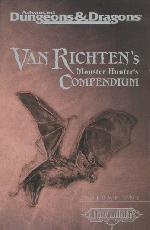
Van Richten's Monster Hunter's Compendiums, Volumne One (VRMHC) also known as Dracula, the Wolfman, and Frankenstein, is a compilation of three other works. This means its a bargain for players who didn't have the originals, and an insult to those who invested three times the cost in older versions of the books. The Guide would have us believe that the product is improved because of a "gorgeous new graphic treatment" and "re-edited."The artwork is nothing to speak of, with miscellaneous Halloween-esque things like skulls and bats littered in black and white throughout the text. Hardly the proposed value-enhancing pictures. If anything, in comparison to the original books subsumed into the volume, the text feels cramped. The artwork in the originals was much better, but then again, there was a lot more room too.
Van Richten has his own notes interspersed with quotes taken from other sources. This lends a welcome creepiness to the text that is sorely lacking in so many Dungeons and Dragons products. It's also more effective than the five thousand random quotes in a lot of White Wolf books that, because they quote a wide variety of sources, inevitably alienate somebody. Since Van Richten has since bought the farm, two sisters (read: the editor) have added their own comments on issues Van Richten was fuzzy about. Why bother adding this extra unwelcome narrative when they could have just as easily incorporated it into the text (like they did with the references to the other rulebooks, below)?
One interesting way in which the Ravenloft supplements treat their subjects is through gray sidebars with the "real rules" and normal text for concentrating on the story. This is supposed to make the Compendium a more entertaining read. Unfortunately, the VRMHC never takes this concept to its logical conclusion. There are peculiarities in how game terms are referenced. "Spellcaster" is used consistently, "humanoids" is used instead of refering to "people" and the narrator is forced to grapple with clumsy game references that either should have been banished to a gray sidebar, or simply abandoned entirely. Not all the rules are placed in the sidebars, which defeats their purpose.
Section One: Vampires
Vampires have long been ignored by Dungeons and Dragons rules, mostly because the myths are so varied and so many cultures have a blood drinking archtype that it takes more than two pages to do a vampire justice. The VRMHC is a remedy to this problem.
Vampires are given age categories and powers -- this is a new trend. The treatment of undead getting stronger with age has been applied to mummies and wights, to name a few. Their other abilities are fleshed out as well. The most useful section is the salient abilities, which enables vampires with powers like the ability to summon gargoyles, pass through walls, and more. Also included are the effects of vampire blood, how long vampires sleep, how effective blessed accoutrements are against them, and the nature of their gaseous, wolf, and bat forms.
What is not explained is the nature of a vampire's level-draining power. This is hardly a power traditionally attributed to vampires, and the explanation given for how it works is bizarre: vampires can drain energy through clothing and armor, but only if they are unarmed. For some reason, the draining power works through the clothing of the victim, but not through the weapon of the vampire -- and yes, metal gauntlets and brass knuckles are considered weapons! It's flippantly theorized that an "open-handed attack symoblizes an action of seizing as much as one of inflicting." Huh?
Make no mistake, this is not a Vampire: The Masquerade version for Dungeons and Dragons. Far from it, the book is hampered by its willingness to detail all aspects of vampires without detailing them so much that you are tempted to play them. To quote under the Vampire with Surviving "Goodness" section:
"This does not mean that a PC who becomes a vampire can remain a PC! The only purpose of this "rule" is to give DMs the opportunity to add some roleplaying spice to vampires. To repeat, a PC who becomes a vampire immediately becomes an NPC, under the complete control of the DM."This very assertive warning is repeated, perhaps not so assertively, on page 101 (shades of Mr. Siembieda's finger wagging lectures). According to VRMHC:
"To put it bluntly, it is strongly recommended that DMs rule PC vampires to be categorically impossible unless using the rules from the Requiem boxed set."I went back to my original Van Richten's Guide to Vampires, and checked the text. That statement about the Requiem rules is, of course, missing. It simply states vampire PCs shouldn't be possible. This is all a little silly. The rules in VRMHC for vampires are intriguing, and indeed is part of the charm of this sourcebook. To dismiss it, unless you use some other published rules (of which no hint nor other reference is given other than above) that obviously does allow undead characters, is insulting. And it just gets better:
"...most players will quickly realize that the pleasure gained from running such a character is fleeting."
This has some implications for folks who play Vampire: The Masquerade, and none of it is very nice. Especially since players can play vampires with the Requiem rules, just not with the VRMHC rulebook.
The differences between this reprinted version and the original Van Richten's Guide to Vampires are minor. The book refers to Domains of Dread and Requiem, but that's about it.
Section Two: Werebeasts
Unlike the Vampire section, the Werebeast section is specifically aimed at what happens to PCs when they become a werebeast. Unfortunately, there are quite a few more varieties of werebeasts (called phenotypes) than there are vampires, so a lot of the information is generalized amongst the many types.
The Werebeasts section covers a lot, including the nature and society of werebeasts, how lycanthropy is spread, how it affects humanoid and demihuman races, the classes they can join, their vulnerabilities, cures for lycanthropy, and bloodlust (like Rage from Werewolf: The Apocalypse). There's even a section on what happens to a pregnant lycanthrope when she gives birth. It's not pretty.
This section ends with an appendix which takes Dungeon Masters through the process of generating a werebeast. This sort of treatment, where the flashiness of Ravenloft is put aside for some direct, easy to follow rules on the subject at hand, is a welcome addition.
If there's a flaw in this section, it's that there are some phenotypes that are just a little silly, and unfortunately the example they use is the Werebadger. Werebadger? This is the Demiplane of Dread, where horrors and nightmares come alive in true gothic fashion, and the best they could come up with was a badger? Werewolverine, weresnake, were-anything-but-a-badger would have worked better.
While stronger than the vampire section in the treatment of its subjects, this section suffers due to the dizzying variety of possible phenotypes and possibly infected races (fear a troll werewolf!). I would have enjoyed a focus on a particular phenotype (werewolves in particular) than a generic treatment of all werebeasts.
Section Three: The Created
I didn't have high hopes for this section. Its inclusion seemed peculiar, as there are other guides (to fiends, and ghosts, and others) that might have been more appropriate. I was in for a surprise.
The Created section focuses primarily on the nature of flesh golems. But it takes the concept of creating life and turns it on its head. The details of creating a golem are covered: how to stitch different limbs together, the biology of a created being, their psychology and mental development (or collapse), their salient abilities, their weaknesses, and the creators themselves.
The Created reads like a guide to Frankenstein. Everything from the love/hate relationship of Dr. Frankenstein and his monster, to the Zeitgebers: triggers that "set off" the golem. Rather than try to accomodate every form of golem, this section chooses its subject and sticks with it.
The accompanying prose is unflinching in its portrayal of golems as alien beings. In one episode, a grief-stricken doctor fashions himself a child out of infant bodyparts when he realizes his wife is barren. In another, a jealous and demented son constructs a "father" for himself out of dead body parts and takes over an asylum. In all cases, the creators' deaths, and indeed the creatures themselves, are tragic, pathetic, and frightening all at the same time.
Unlike the vampire section, there's even rules on playing a PC golem. Bravo!
This is what golems should be. The repeated emphasis that Dungeon Masters should use the golems presented in the various Monstrous Compendiums only as a guide is an indication of just what is missing from the golem myth in Dungeons and Dragons.
Conclusion
Each of these supplements originally sold for about $11.00, which means you're getting a $33.00 value for $25.00. That alone provides incentive for Dungeon Masters who want to include this material in their campaign.
Ultimately, this book is a worthy companion to the Monstrous Compendium. In fact, this information should be in the Monstrous Compendium. It shouldn't require a Ravenloft supplement to make a monster uniquely horrifying.
For Dungeon Masters who want to flesh out vampires, werewolves, and golems, this book is a valuable, if somewhat pricey, addition. For players who want to explore the darker sides of these three subjects, buy Vampire: The Dark Ages, Werewolf: The Dark Ages, and...err, well there's no book for playing golems yet (unless you count the Risen for Wraith).
Review by Michael Trescahttp://www.retromud.org
http://read.at/tmb
Style: 3 (Average)
Substance: 5 (Excellent!)

