

 Search
Review Editing
Review of Werewolf: The Wild West
 Goto [ Index ] |
The first reason for this is that I've been a big fan of the Werewolf: The Apocalypse game for years. It was my re-entry into roleplaying after about five years of inactivity, and my introduction to White Wolf's impressive World of Darkness setting. So the reader should read on with the realization that I'm approaching this as an established fan of the essential background of this game, not as a more objective newcomer. This'll make the review more valuable for some, less for others.
Second, and more importantly, I was until the Christmas '96 layoffs an employee of White Wolf, and there are a lot of folks there I like quite a bit, including Ethan Skemp, the developer of the game at hand. And I actually wrote part of this book, so any possible objectivity I might bring to bear is therefore highly questionable.
The review won't be comprehensive, either;I'm writing for my living now, and had to fit the review into my schedule. As a result, it may also be a bit over-long since I had little time or financial incentive to streamline it. :)
So, with all that out of the way, here we go...
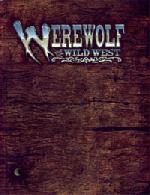
I'll start with the package itself. Werewolf: The Wild West, like its predecessor, is a hefty hardback book. Its cover price is $28 U.S. The cover motif is weathered wood and a stylized silver logo, and it looks tres cool.
Inside, we get a look at the "Savage West" from on-high with a map that forms the end-papers, front and back. The map, like many things in the White Wolf canon, is more inspiration and attitude than detail and information, but for what it is it works fine, and is very attractive.
The book is printed on a yellowish, parchment-style paper, with the type and illustrations in brown ink.
One other little tidbit: there's a die-cut "bullet-hole" through the lower left corner of the book. All the way through. Some might find this gimmicky. It is. It also doesn't look much like a bullet-hole. I guess you could put a cord through it and carry the book over your shoulder, though, if you want.
The overall effect is elegant and effective. The book looks and feels darn good. Basic packaging gets an A-. Woulda been an A if not for the stupid hole. (I wrote that last a couple weeks back, and in retrospect, I think I may have understated the "bullet-hole" issue. The more I see it, the less I like it. It makes the book look like a damaged remainder you got on sale somewhere).
Next, we all, of course, flip through a new game-book and look at the pictures. As usual, there are some in here that are flat out incredible, some that are merely cool, and a few that would make good emergency paper when the Sears Catalog in the outhouse runs thin. Some of the strongest pieces are by Ron "I'm an art god" Spencer and Brian "I run hot and cold" LeBlanc, and there are some hellacious Scott Fischer pieces too. Andrew Bates turns in some solid work, if somewhat sketchy at points, and Richard Kane Ferguson fans can look forward to some balls-to-the-wall two-page spreads that show just how friggin' weird this west can be.
All in all, the art is good and solid in the book, but not as good as it might have been. The thrown-in-because-we-paid-for-em-already pieces detract from the whole. So I'll give the art a B+.
Now, the important stuff.
My overall first impression of this game is "Holy smokes!" I liked Werewolf first edition, thought second edition made some good attempts at improved clarity and added a bit more useful information (though not enough to justify buying it if you had 1st edition), but now, at last, there's a Werewolf rule book that's consistently and thoughtfully put together. We're still stuck with the clunky and kludgy Storyteller mechanics, alas, but the strength of White Wolf's games has always been the imagination and creativity brought to bear on the details of the game world, not the systems tossed in like an afterthought to run them.
It must be said, though, that this is actually Werewolf 2nd Edition in chaps and spurs; if you already have the original game, you'll be spending $28 for what is actually a rather thin western supplement spliced into the modern game. But more on that as we go.
Werewolf: The Wild West brings us a rich background for horror adventures in the old west. Ethan Skemp had a solid vision for the setting, and as a result managed to wrangle an internal consistency from his creative team that would make any developer proud. The book is put together cleanly and logically, and is a helluva lot of fun to read.
For those whose minds turn to visions of ridiculous camp when they hear tell of this game, rest assured that is most definitely not what Ethan gives us (though there is an entertaining short essay on the possibilities of camping it up, if that's what you want to do). The Savage West is a horror setting, laced with the mythology of the wild west and with vital layers of folklore and spirituality. What Werewolf: The Apocalypse was always supposed to be, Werewolf: The Wild West is. Ethan has a powerful sense of Garou psychology, spirituality and society, which he brings to bear on this setting with marvelous effect. As a result, the game offers players the chance to play serious characters in a complex, deadly, and very strange world. This ain't "F-Troop" in furs, no not at all.
(For those of a mind to play a western-horror game that takes itself less seriously, there's always Deadlands from Pinnacle Entertainment Group. Deadlands is pulp pure and perfect, with all the mad scientists, altered history, cheesy dialect, and zombie gunfighters you could ever want. Deadlands is actually a far superior game, both systems-wise and in terms of the availability and quality of available material. Due to this, I could easily recommend the Werewolf book as a source material supplement for Deadlands, were it not for the cost).
For players of the contemporary Werewolf game, know this: there ain't no Pentex Corporation, there ain't no Seventh Generation, there ain't no misbegotten Samuel Haight. There are fomori, but in the old west they were called "mockeries." And there are a lot of other colorful setting-specific critters to rumble with in your personal "Not-So-OK Corral." But in the Savage West, the big baddie you have to worry about is something called "The Storm Eater."
But we'll get to that.
The book opens with the by-now familiar introductory short story (we're spared a crappy comic book until the short "Example of Play" towards the back, which actually has value; thank you, Ethan). This one involves a group of werewolves sitting around playing poker (did you expect anything else?) and introducing a new cub to his life as a Garou. It's flavorful, though the prose tends towards violet and isn't going to send Cormac McCarthy into spasms of envy, but falls victim to expositionitis as most "tales" like this do. I'd rather see a good story told that gives me the feel of a setting than just have a bunch of talking heads list all the basic facts of the game world over a bunch of monotone pages; after all, this stuff is explained in much better, and more entertaining, detail just a short way into the book, so why not catch the reader's attention with something more dynamic? (For a good example of how to do it right, check out the story in the front of Daedelus's Feng Shu! i). That said, the piece does what it sets out to do, if a basic recital of what's to follow is all that was desired.
One very minor quibble: one of the things that has always disappointed me about White Wolf is that they produce these great, creative, sometimes even mature works, and have to toss in needless juvenilia. There's certainly a place for such stuff, and it can even be fun (see Freak Legion), but it doesn't belong where it detracts from the work upon which it's inflicted. A line in this story clunks off the page as not-exactly-genre, and is just a bit of unnecessary cuteness on the writer's part: "So, Aaron Stick-Up-Orifice, or whatever you're calling yourself..."
The Gods of Prose and Diction smile upon us.
A minor point, as I said. Certainly not ranking up there with cool classics like the line about licking ripple and cum from our lips at the very start of Destiny's Price for Mage (after all, that's for, ahem, mature readers). But a bit of grit in the boot all the same.
Next is a short piece called "The Coming of War," which is the Savage West's version of "The Prophecy of the Phoenix" in the parent game. This, too, is a prophecy, but one given by a long-dead Theurge of the extinct Croatan tribe. It foretells the coming of the Europeans to North America, and along with them, the return of the Wyrm, and sets up one of the crucial themes of this game: out-and-out war between the tribes:
The worst of all things will also happen. The others, the long-vanished
wolf-changers who are like us and very much not like us, they will
return. They will run with the empty-bellied people and the evil people
and the hollow-eyed people, and they will fight the children of the Pure
Lands. They will say that they are not of the Weaver or the Wyrm, and
yet they will blindly break the old seals and angrily fight us for our
sacred places. Only after many seasons will they see how foolish they
have been, and by then the Pure Lands will be no more. The land will
be sick, and our people will be hungry and cold.
This theme is explored throughout the book, and the conflict between the native werewolves and the European ones serves to dramatically exhibit the underlying tragedy of the Werewolf game whatever the era: the Garou are their own worst enemies. If they could just get along and get to the business at hand, they'd be a very effective deterrent to the Wyrm. Instead they bicker and fight and divide themselves, and the bad guys slip through the cracks between. This theme is present in the modern game, but in play the conflict between tribes is often relegated to in-character sass between uppity Garou of different tribes. In the West, the conflict is essential and deadly.
White Wolf is often accused of being overly politically correct, and sometimes this is true. Some will find the treatment of the Europeans vs. Indians to be one of these cases, and to a degree they would be right: yes, the Europeans are portrayed as despoilers, and the Indians are portrayed as spiritual warriors allied to the land. But a good argument could definitely be made that such portrayals are accurate: we are, after all, talking about indigenous people who were slaughtered and cheated for their land, and about invaders who took such honorable measures against their victims as spreading small-pox to wipe them out. Still, I had hoped to see a bit more of the dark side of the natives as well; they were as flawed in ways as their conquerors, aggrandizing myths notwithstanding.
To continue the tour, though...
Next we get the usual smattering of setting info and game background. We get a rote recital of sixty years of history, we get told what a werewolf is, we get capsule descriptions of the different tribes, we get a glossary of werewolf patois, we get background on Garou society, on caerns, on antagonists, etc. In other words, the standard package for a Storyteller game, only written to reflect this setting. That's not a bad thing, mind you: the summary nature of this info, right up front, is valuable to folks just coming to the game, and this section serves as a good primer for players being introduced to the setting (with the Storyteller hogging all the real nitty gritty for himself).
Speaking of which, this game is the perfect opportunity for seasoned Werewolf Storytellers to surprise their players with cool new stuff. Because of this, I'm going to avoid going into too much more detail and just cover a few things in general terms.
One such thing is the fact that this game isn't just a simple graft of the modern game's background into the old west. The world of the Savage West is actually significantly different than the World of Darkness we know, not only in this world, but in the spiritual world of the Umbra as well. The Umbra in this setting is known as the "Storm Umbra" because it's an even stranger and less predictable place than the Umbra of today. It is whipped by horrible storms, stirred up by the onslaught of Weaver forces from the East as they try to vanquish the spirits of Wyldness in the West. The membrane between the worlds is weakened, and even broken, at points, and things slip back and forth that you may not want to meet at midnight. And a traveller never knows when they'll take a left turn out of reality into one of the "Broken Lands," places where things just ain't quite right...
The Gifts and Rites of the Garou have been altered as well, to better reflect the needs of Savage West werewolves (times do change, after all...). I think my favorite Gift is "Ghost Town," which has all kinds of story possibilities. All the tribes are also firmly established in the West in a sensible, interesting, story-rich way, and things that needed changing, like changing the Glass Walkers to the more period-true Iron Riders, have been changed.
I mentioned the Storm Eater before. Only a few know about this thing, and fewer still have any inkling of its true nature. The Storm Eater is an enormously powerful Bane of some sort, out in the Umbra, wielding the powers of the Wyrm and the Weaver and causing all kinds of problems. Other setting-specific antagonists add a lot of color: Texas Tarantulas (everything's bigger in Texas, right?), Cyclones, and Desert Wind spirits. The Night Hunters gave me a frisson of Storyteller glee as I read their description and thought of ways to use them in a Chronicle (though I did, admittedly, recognize them as the Nazgul from LORD OF THE RINGS, which ain't much original). More of this stuff would have made the book better, but what there is is pretty good.
A little thing, for those who remember: in true Werewolf fashion, there is even at least one "See page xx" reference in this book, but hey, there had to be, right? Ironically, it's in one of the parts I wrote, on page 185, under Health. I'm happy to have been a part of this much-honored tradition (though the reader should know that the xx references are written in as spaces to be filled when the final manuscript is ultimately assembled and someone can do a simple Find command to get at them all and put the pertinent numbers in; the fact that one still got through both development and editing on the book indicates that maybe one of Deadlands' gremlins was sent to monkeywrench the competition).
There is Indian lore in the book, and the use of the Native American spirituality is one of the book's main strengths. Unfortunately, this strength is diluted in places where authors seem only to splice a very superficial understanding of an item, entity, or concept into White Wolf game terms. A lot of this will go right by the average reader, and doesn't really impact the game itself, but it would have been nice to see medicine bags that seem like actual medicine bags, dream catchers that seem like what traditionalist Indians think dream catchers are, and "Manitous" that have something, anything, to do with what "Manitous" are in native beliefs. A minor thing, easily fixed by anyone who actually knows something about these things.
Werewolf: The Wild West has the POTENTIAL to be a captivating, rich gaming background (it still really needs a LOT more setting-specific material in a supplement or three -- as pointed out ealier, if you have Werewolf 2d edition, you basically have this book too, just written a bit differently and with certain chunks of background pasted in). A good Storyteller can take this book and use it to run adventures that will scare the pants off his players, or move them incredibly, or even teach them some things about history or about themselves.
If you like Werewolf, you'll like this. If you don't like Werewolf, you might still like this; give it a look. It's just as action/adventure oriented as its parent game, but it has a certain thoughtfulness (I won't go so far as to say subtlety, because the Garou ain't that, but Ethan is better at nuance and continuity than previous developers on the line) and texture the parent lacks.
Grade of the game itself (not bothering to take mechanics into account since they're a known evil by now): B+. Drop this to C if you're already a Werewolf player, and have the second edition, in which case you'll be buying a lot of material you already have.
By the way: if you run this game without also having gotten yourself a copy of Nuwisha, which details the were-coyotes, you're a goldurn tinhorn fool! (Not because you can't run it without it, or need it for vital info, mind; it's just that the book's so cool and the Savage West is the ideal locale for the coyotes...) You wouldn't go wrong by bringing in were-cougars from Bastet, either.
One final reviewer's caveat: avoid the Werewolf: The Wild West Poker Deck. It's a cynically produced piece of crap, with awful art, clumsy yellow smears drawn along the edges with some graphics program to simulate wear, and the game's logo on the back instead of something that would look more evocatively period. No art nor craft went into this item, only crass merchandising think.
Style: 4 (Classy and well done)
Substance: 3 (Average)
Editor's note: we do have a general policy that writers cannot review their own works. Because this review took that into account, we decided it was worth publishing, especially given the amount of useful information contained. As usual, our full review policy is available by web. - Sandy Antunes, RPGnet reviews -

