

 Search
Review Editing
Review of Puppetland/Power Kill
 Goto [ Index ] |
This book is actually two separate entities entirely, so there is really going to be two reviews. The first part I'll review is Power Kill(PK) after which I'll review Puppetland(PL). Before any of this, however, there is some commentary.
Hogshead Publishing seems to be embarking on a new direction for the role-playing game industry. They have apparently figured out that conventional RPGs are a no-growth industry; that to attract new gamers publishers will have to make new games. The first entry in Hogshead's line of such games was the ever-popular RPG(?) The Adventures of Baron Munchausen. Apparently the experiment was a success: Hogshead has added two new games (in one volume, admittedly) which are definitely non-conventional. I wish them nothing but good in this vital endeavour.
In addition to this, I should comment on the production values and such since this isn't germane to the actual games' reviews.
Both games have spectacular layout and great, tasteful art which augments the experience of reading the rules. For the money I don't think I've made a better purchase for my gaming dollars outside of, possibly, Big Robots, Cools Starships from Guardians of Order. And this even given a 24-page volume!
Power Kill
Power Kill(PK) is an eloquent, and sadly accurate, rant about the role-playing gaming hobby disguised as a metagame used to enhance the FAE (Fun and Excitement) of a NRG (Normal Role-playing Game). (The TLAs in this part of the review are all from PK itself.
The premise of PK is that the characters in a NRG are the delusional personas of PKCs (Power Kill Characters) who are themselves mental patients in a hospital for the criminally insane. PK is played by having the GM (called Counselor) run a short session before a RGS (Regular Game Session) in which the NRG character is asked a set of questions about their capabilities, the danger which surrounds them, etc. After this the RGS runs as normal.
At the end of the RGS, PK takes over again and the Counselor explains the events of the RGS in terms of real-world events. So, for example, if the NRG characters invaded a dungeon and killed monsters, the Counselor could explain that the PKCs are locked up because they entered an apartment building and slaughtered racial minorities (looting the bodies as they went, of course). After this the questions which were initially asked of the NRG characters are now asked of the PKCs.
The point of the exercise, of course, is a very eloquent rant about how most "heroic" RPG characters are little better than thugs and criminals. Indeed, in most games, the characters are run contrary to the laws and morals of the setting they're in, not to mention our own laws and morals. By wrapping up an RGS in the PK sessions and stripping them of the veneer of respectable things like "genre conventions" and the like, John Tynes highlights in excrutiating detail exactly what is wrong with the adolescent fantasies which make up the vast majority of this hobby's activities. The effect is both wondrous and disturbing. It is hopefully also a wake-up call (although the point will be lost on many or most who read the "game").
Puppetland
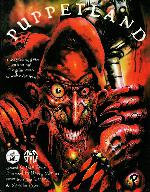
PL is a diceless, story-telling (in the truest sense!) game of lost innocence in which the characters are puppets (finger puppets, hand puppets, marionettes and shadow puppets to be precise). The puppets live in a wondrous land made for their own protection from the evils of the human world. Unfortunately one of the puppets, Punch (from the famous Punch & Judy shows), killed the benevolent Maker who built the land and, adopting a mask made of the Maker's own flesh, has become its tyrant. The puppets the players play have the goal of bringing the Maker back to life (Judy, once Punch's lover, has a thimble with the Maker's last tear which she believes will accomplish this task).
PL sports many interesting innovations in game play, several of which will intrigue or annoy depending on one's predilections:
- All PL game sessions are 1 hour in length. This is in real world time, not game time, but the puppets are somehow aware of the passage of real world time as well as of game time. When an hour has expired, the session ends and at the beginning of the next session the puppets, no matter their condition, arise in their beds (or wherever) hale and hearty and ready to embark upon their next tale.
- All interaction is done in character. Period. End of sentence. If your character is going to get a class of milk for a visiting dignitary, for example, you do not say "Jenny Blue Bonnet goes to the fridge to get a glass of milk" as a player, you say, as Jenny Blue Bonnet, "I shall go to the fridge and get a glass of milk for you, Your Honour" (or whatever). The puppetmaster (GM) uses narrator exposition to communicate. You don't say "the door bursts open and a nutcracker barges in threateningly", you say "Hark! What light through yonder front door breaks! It is an evil nutcracker, come to avenge his fallen comrade!" (or perhaps something less silly).
- Damage (from combat or whatever) is ephemeral for the most part. Damage sustained -- even horrid damage -- is repaired by the next tale, however; when something particularly horrid happens to a puppet, a piece of a jigsaw puzzle on the character sheet gets filled in. When the last piece gets filled in, that is the end of the character, permanently. The puppets know this, of course, and know when their doom catches up to them. This makes for some very potentially dramatic play, even in this guise of a child's game.
PL is a very interesting game of symbolism. (To its detriment, John Tynes feels the need to explain the symbolism at the end of the rules. Given the state of the hobby shown in Power Kill, however, this breach of good taste can be forgiven.) Being a consumate professional (as well as a paragon of creativity) he makes the symbolism come alive with his very detailed and flavourful setting. (It's amazing what you can pull off in 20 pages!)
PL will not appeal to the tastes of all, certainly. It is nonetheless an important expansion of our hobby and it is important that even those who in the end won't enjoy the game read it and understand it. It never hurts to broaden your horizons and learn a new way of looking at things.
Conclusion
I have written a very long review for 24 pages of text and images. It is long because Puppetland / Power Kill is a very complex and dense work which belies its tiny size.
It is without a single doubt (and without any perceived exaggeration) that I say Puppetland / Power Kill belongs in the tool chest of each and every role-playing gamer in the English-speaking world. I'm not kidding. For the money there is nothing better on the market; or, at least, nothing which will expand your role-playing horizons by anywhere near as much.
Style: 5 (Excellent!)
Substance: 5 (Excellent!)

