

 Search
Review Editing
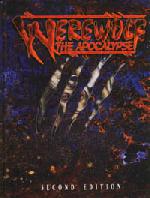
Review of Werewolf: The Apocalypse
 Goto [ Index ] |
A lot of folk have pointed out that the problem with Werewolf: The Apocalypse (Werewolf, for short) is that the end is near, everyone knows it's the end, and who wants to play in that? Well, if you think about it, the Call of Cthulhu setting is much the same. A seemingly unnatural (but ultimately more natural than humanity) series of forces will squash humanity like a bug. We aren't an issue or a problem, we're merely an unfortunate side-effect of the Weaver/Elder Things. Something kept the destructive forces in check (the Outer Gods/Wyld) and ultimately the balance is shifting towards utter destruction (Cthulhu and co. awaken, the Wyrm destroys everybody). So why is it that Call of Cthulhu is considered a classic, and Werewolf ain't?
Horror.
That's it. A simple ingredient, but a very significant one. Werewolf is a mixture of dark gothic fatalism and spiritualism, part Seven-Samuraish "take as many as you can with you," part the resigned native watching the land being turned into a landfill. But horror? That's missing.
So how do you turn a movie monster and an archtype of the human psyche into a playable game?
- You take that whole moon thing out. Werewolves are heavily influenced by the moon, or their Auspice, which determines their "classes" (I'm an old D&Der, sorry) and their Gifts (spells/skills).
- You distinguish the Werewolves based on the many breeds of canines. Weirdly, "breed" doesn't really mean that in Werewolf, the proper term is tribe. But you get the idea.
- There's different breeds of Werewolves -- the kind that is bred from wolves, bred from humans, and bred from other Werewolves (which is bad, BAD DOG!).
- You give them a foe more powerful than they. Werewolves fight the Wyrm, which is sort of like the Dark side of the Force. It's evil incarnate, and sometimes not so incarnate, and it is all corrupting.
- Werewolves don't fit in, because of the Rage. They have a surly supernatural aura about them that keeps them from blending. Werewolves are protected by the fact that most humans can't deal with the existence of Werewolves at all. This cloak of forgetful, "it wuz just ah dawg!" rationalizations is called The Veil. Tear The Veil away, and boy do people go nuts. And we're talking pee-your-pants, run screaming for your life kinda nuts.
Can you hear the Cthulhu fans screaming? No, they're not being devoured, that's because Call of Cthulhu was there first with Sanity checks. Same effects as a matter of fact. Only The Veil mends itself. People forget soon after what happened. If only the poor fools in Call of Cthluhu COULD forget...
But this is another significant divergence from what makes Call of Cthulhu work. Certainly, scaring the piss out of people has appeal. But Werewolves are on the other side of the coin. They're not being terrified by the horrors they face, they're doing the terrifying. This certainly takes the creepiness away from fighting supernatural, twisted horrors. Who cares, you're not too much of a charmer yourself, dogboy!
- Werewolves are dangerous, powerful slasher types who can tear things up, including Fomori. A group of Werewolves can tear up an entire block. In comparison, humans can be chewed up pretty quickly by a Werewolf. In fact, Werewolves fit right into the power-level of Call of Cthulhu. In both games, humans have their wits, maybe a firearm, and they can run away fast, but that's about it. Werewolves, on the other hand, are quite capable of holding their own against the supernatural. A human running up to Cthulhu would -- nevermind, he's just died a horrible death.
- Werewolves are fighting a lost cause. The end of the world as they know it is nigh. They know that from the start. It's not a slow realization like Call of Cthulhu, where their canineocentric universe comes undone. There's no "Wyrm Mythos" to gain in to represent the knowledge of what the Wyrm really is and what it's plans really are.
Here's a divergence from Call of Cthulhu: The evil things that slurp and slither ARE tangible, all too tangible. They can be touched and they can touch you. This makes them all the more terrifying. The "Elder Gods" aren't so godlike, but the fact that something "real" could be that powerful makes it even more horrifying. The Wyrm is no Cthulhu. Cthulhu makes the Wyrm look like a blundering oaf. Cthulhu haunts peoples dreams, the Wyrm starts a corporation named Pentex and puts something in your drink that makes you look like the Toxic Avenger. That's not a joke kids: "Yes, Junior has indeed become more violent, and his grades have dropped, but who would attribute this behavior to the Action Bill doll (made from Pentex plastics) that he received for Christmas?" (p. 47). That's a bit hard to swallow -- the angry, violent, all-consuming Wyrm has corporate suits working for it. Cthulhu may have cultists...but somehow I doubt he does many corporate takeovers. Back to Werewolf...
Then there's the Umbra, which Werewolves can shift into under certain circumstances. Sort of like the Dreamlands.
After buying both books, I came to the conclusion that Werewolf and Call of Cthulhu, collectively, could make for one very interesting, albeit admittedly weird(er) campaign. Werewolf is different from Call of Cthulhu in that Werewolves fight to save the forces of Nature, and they know they're losing. In Call of Cthulhu, humanity's unlucky if they disocver the truth that the world's coming end.
Why such a divergence? Well, it seems like Werewolf is marketed for a younger set. And yet, the emphasis on role-playing requires a more mature handling of it all. Contradicting the mature theme of Werewolf is the goofy-looking comics by DiTerlizzi, who needs to stay away from the human form and stick with big ookie monster-types. Werewolf wants its players to find honor and dignity in heroic deaths that ultimately are meaningful only to the survivors -- and since there won't be any survivors, it doesn't mean anything at all. Call of Cthulhu, conversely, has a prideful sense of the "grand olde men" who die in honorable service.
Perhaps most importantly, the rules behind Call of Cthulhu are designed for a gradual slip into doom. Sanity just goes down and down and down. Werewolves, on the other hand, have every reason to believe that maybe, just maybe, they CAN turn back the tide of the Apocalypse. Enjoying the slow destruction of a character requires a certain level of maturity and mindset. Werewolf flirts with the Apocalypse mindset but doesn't position the rules to support it.
Is Werewolf a good game? Yes. The raw power of what Werewolves are about, the dichotomy of spiritual peace vs. animalistic rage, the bright cities and the dark woods, all make for a very appealing Little Red Riding Hood setting where playing the Wolf is a lot of fun. But it's a very specific mindset that can easily tip into hack-n-slash (seeing a Werewolf fire its NAILS at someone in machine-gun like fashion is one example). This is probably not what the creators intended for Werewolf as a continuing theme. Spurts of berserk rage maybe, but not walking holocausts of fury.
No wonder, then, players change the game so that the Werewolves have a chance of winning. The game teases them with more and more power, then expects them to buy into the philosophy that they're doomed no matter how many gifts they get. If Werewolf truly wanted to invest in the fatalism mindset, they'd have to take some lessons from Call of Cthulhu in the frailities of the partially human mind.
One last note: playing in a different era, when Werewolves aren't running around screaming about the Apocalypse, avoids this issue entirely. I'll let you know if it works when I get my hands on a copy of Werewolf: The Dark Ages.
Style: 3 (Average)
Substance: 4 (Meaty)

