

 Search
Review Editing
Review of Corum
 Goto [ Index ] |
Why it's Cool: Brilliant armies with armor made from giant shellfish marching across a sinking continent covered in delicate flowers, rampaging hordes of grim barbarian axemen, glittering fey palaces with the last scholars of a genteel and dying race, grim fortresses and storied ruins, bloody clashes on chariots, frothing chaotic wastelands with warped and bestial inhabitants, glittering cities of the air, clockwork marvels and crystal-powered technomagic are a few of the things you'll find in Corum. If you want a fantasy world that manages to be lush, epic and grim all at the same time, look no further. Because it is powered by the Stormbringer system, the combat is fast and furious and the system is sensibly realistic without being unheroic or bogged down in too much detail. Oh, and it's about the dialectical relationship of Myth and Enlightenment.
My Bias: I don't think Moorcock is that great of a writer, and I really hate the character of Elric in particular. Nonetheless, I think that he raises very important and interesting ideas. Of all of his eternal champion books (that I've read, at least), the Corum books were my favorites. As far as RPGs go, I like games that are not merely juvenile power-romps intended for the socially stunted (which means I don't like many of them). I particularly like the Stormbringer system, which from a mechanical standpoint is realistic yet playable. That's where I'm coming from on this review.
What Stormbringer is: Stormbringer 5th edition is Chaosium's dark fantasy game. The point of it is that there exists a Multiverse in which the forces of Law and Chaos battle for supremacy. Chaos is the force of unbridled creativity and destruction; it is both beautiful and tyrannical at the same time. Law is the force of stability and rigid conformity; it is both beautiful and tyrannical at the same time. Both are personified in deities and actively recruit sapient beings, particularly the impressionable species homo sapiens, to do their bidding. Both accomplish the same thing through different rhetoric: the total domination (and thus negation) of whomever embraces them (sort of like some political parties I can think of). Then there's the Balance, an enigmatic force which offers few boons and demands much (it's also the only force which is entirely humane). While Balance musters no armies, its (unwitting) servant is the Eternal Champion, a tortured wandering archetypal badass who does the will of Balance even while he thinks to serve Chaos or Law. In the Young Kingdoms, this person is Elric. In the World of the Five Planes, it is Corum, the Prince of the Scarlet Robe. Characters in the game almost invariably become involved in this clash of largely careless titans; they may or may not pursue their ends even upon other planes of the Multiverse.
What Corum is: Corum is partly a worldbook for Stormbringer, partly a set of new and supplementary rules, and partly an idea mine for dark fantasy in general. As a worldbook, it details the geography of Corum's world, discusses its history, describes characters both common and unique, provides character creation rules specific to the world and provides story ideas and even 3 full scenarios. As a rules supplement, it gives you rules on new skills, new weapons, new ships, an entire system for chariots and plenty examples of the same, an entire system of dynamic sorcery based upon the combination of various "chaotic effects", an entire system on the construction of Lawful contrivances (potentially potent technowizardry based upon the incorporation of special crystals), a system for elemental tattoos, and undoubtedly more which I've overlooked. It is certainly a lot for your money in that respect. As an idea mine, well, that's harder to quantify. The book is extremely well written in most places, and even the descriptions of the locales are packed with ideas which could easily be transported into other games. And since the entire premise of the game is based around the idea of a Multiverse, there's certainly room for practically anything else to be brought into contact with it. There's even a random plane generator, though I can't imagine a GM in his right mind who wouldn't just come up with a cool stock planes and whip them out when necessary... but a small slice of the Million Spheres, in any event.
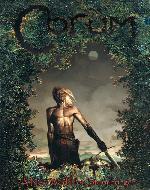
What's going on in the Corum setting: Corum's world is not Elric's world. They're both dark, that for sure. But they are not the same. For one thing, Corum is based upon Cornish/Celtic myth. The Hounds of Annwvyn even make an appearance, for all you White Book of Rhydderch fans (gamers who don't know what I'm talking about get docked 5,000 geek points and get sent back to undergrad). Basically, you've got the humans (or Mabden), a race of curious contradictions with which we're all painfully familiar (at least, I hope we are). Some are civilized, and live on the delicately beautiful though unfortunately sinking and somewhat socially moribund continent of Lywm-an-Esh. Others, prone to wearing ratty clothes and killing people, live on grim Bro-an-Mabden (leather-clad axe-wielding chariot-riding coast-raiding barbarian types). Recently, the barbarians have expanded to Bro-an-Vadhagh (VA-thahkh), the beautiful land of the cultured and reclusive Vadhagh (it won't stay that way for long, unfortunately). The Vadhagh are like the faerie: they live in magic castles, seem frightening to normal folk, they can plane-shift (seeming to go invisible, only to reappear elsewhere), have (apparently) magical artifacts, and know many things. Corum, the hero (pictured on the cover, after having been mutilated) and last of his race (the game is set before certain things go down), is a Vadhagh (again: VA-thahkh). Vadhagh characters, though more-or-less doomed, can start out with all sorts of nifty scientific knowledge. Then you have the Nhadragh (like it looks, but with the "gh" like the "ch" in Scottish "loch"), a species almost extinct by the time of the novels, who were a sea-faring counterpart to the Vadhagh until being subjugated by the barbarian Mabden; the Ragha-da-Kheta, a spindly species of doomed fatalists (well, at least they were right) clothed in feathers and with a whole bird motif going on; and the Shalafen, a vaguely-described group of sea-dwelling communists with magical tattoos living in castles built among dazzling coral reefs (and hanging out with whales). The civilized Mabden, the Nhadragh, the Vadhagh and the Shalafen worship Law; the barbarian Mabden and the Ragha-da-Kheta worship Chaos.
What is the setting *like*? Well, for one thing there are a lot of juxtapositions of beauty and ugliness. Some places are wholly beautiful (Lywm-an-Esh, the Vadhagh castles) but are waning; other places are brutishly ugly (the barbarians, Kalenwyr). Corum (and also each of the Nhadragh) is beautiful but marred by ugliness. There's a lot that can highlight the ephemerality of beauty, the apparent tragedy though inevitablity of change, and the question of whether reason or will is the ruler of humankind (or whether there is ultimately a difference). For those familiar with some of the Law vs. Chaos stuff from Moorcock, Law is really the sympathetic underdog here. However, it's always worth bearing in mind that Law and Chaos are really the same - Chaos stresses repetition just as much as Law does (just in different ways), and both seek to dominate the external and reshape it in its own image. It's merely a choice between a tyrrany of Apollo or Dionysus.
The Rules: There are several sections which I'll briefly address:
Skills and Occupations - There are around 30 new occupations which capture the distinct flavor of the setting. They range from Explorer to Philologist (as I noted, the Vadagh are quite the little scholars) and describe likely backgrounds, starting skills and equipment. The skills section includes new gems like Avocation (the scholarly meta-skill) and Precepts of Contrivance (for Lawful device-making), as well as rehashes of old skills and a couple of dubious inclusions, such as Surf (dude!).
Weapons - This section largely just renames some of the Young Kingdoms-specific weapons from the main book. The big gaffe here is the interpretation of the longsword, which is given a length of Long (same as a longspear or halberd) - sorry, no. See the Unknown East sourcebook from Chaosium for far more reasonable interpretation of that weapon.
Ships - What would Stormbringer be without ships? This is a good, concise section. Also, watch out for those flying ships. Perhaps my favorite sentence fragment from the whole book is a dropped reference to a potential encounter on any civilized world, the "sapphic amazon catamaran". Puzzling, yet strangely exciting (I think it should be remembered that Amazons don't come from the Amazon, they come from Scythia, and Sappho was from Lesbos, which is an island in the Aegean - but hey, whatever floats your boat!).
Chariots - This is an excellent section, potentially useful for many settings. The rules focus on combat on, from, against and between chariots, as well as races and chases.
Sorcery - Spellcasting gets a complete overhaul in this book. The ingenious system devised for the Corum world uses a list of possible sorcerous "effects" (Darts, Mist, Vampire, Ward , etc). The sorcerer summons one or more effects to produce the spell effect he wants. Just choosing Darts and you will be shooting magical bolts of energy. Choose Darts and Paralysis, and you get paralysis bolts. Choose Fire and you get fire. Choose Fire and Baffle and you'll be putting the best Firespinners to shame. Naturally, there's all kinds of stuff you can do with a system like this. The sorcerer puts a certain number of points into the Intensity of the effect, as well as Range and Duration. A Luck roll determines success. Interestingly, the effect takes a random amount of time to be cast, so a sorcerer must be very careful. Also, a new kind of beastie may be summoned: Chaos Creatures. These are like demons but less versatile and more combat oriented. A roster of sample Chaos Creatures is provided. Several of them could easily stomp most adventuring parties. Also, magical charms of the Ragha-Da-Kheta, called fetishes, are briefly touched upon (with 6 sample items).
Chaos Traits - This section has a good all-purpose table for determining the physical warping effect of Chaos influence on a human body. Gaining 10 points to Appearance and Poison Touch sounds almost useful, but animate sores all over the body does not. Tread carefully, malefactors! There are rules on how characters acquire such traits from over-exposure to Chaos, but I will speak on this a little later (the rules are somewhat broken as they stand).
Contriving - This is the Lawful 'science' of creating mystically-imbued items of Lawful perfection. These are such things as Quality swords and fabulous clockwork devices. The require a long time to craft and demand great skill (as you would expect from those Law guys). Crystals are incorporated into the devices to power them. They function as minor magic items, with such things as weapons that always strike for maximum damage, mechanical limbs, and even a large chair on mechanical legs that can plane shift itself and a passenger.
Elemental Tattoos - These are interesting but logistically unwieldy Lawful incisions that provide special powers or skill bonuses. These are based in intensity upon the number of weeks spent getting tattooed (you basically can't do anything else), and so are really difficult to manage since the people who know how to do them all live underwater (though they can come to the surface). A 5% bonus to a seafaring-related skill per week of incision is a common type, though some make ships you are on move faster or give you the ability to breath water.
The Uncool: There are a few flaws in Corum, although I don't think that they seriously detract from the excellence of the work. In no particular order, one thing that I consider a flaw was the tongue-in-cheek naming of some of the sample contrivances. For example, a chariot Contrived for extra speed is called "Hot Wheels". An Appearance-increasing fetish of the Ragha-Da-Kheta is called "Love Me, Do!" Umm... let's see... let me think about this... NO. Hot wheels indeed.
More importantly, the rules for the acquisition of Chaos Traits are seriously flawed. Essentially, when a character who has a Chaos total higher than her Law or Balance gains 1 or more points of Chaos, she rolls %. If she gets under her Chaos score, she gets a trait! This means that a character with an 80 in Chaos gets 4 traits per 5 spells she casts! And they're almost all major bad news. Therefore, the average sorcerer would walk around looking like an improperly-assembled Cthulhu model halfway through the campaign. And it's not just sorcerers - anybody gets those traits (if the GM runs it as written) for any Chaos point acquisition. So a really freespirited person is going to be a walking monstrosity before long. It's total nonsense. However, it is easily fixed. You can just assign the traits based on Chaos point total (1 per 20 points if a spellcaster or 1 per 50 if a not a spellcaster or any other such scheme) or whatever else seems suitable. Anyway, it's a minor rule and there's no difficulty in patching it since nothing else really relies on it.
Lastly, the Allegiance points and Million Spheres percentages for some of the characters are outlandish. Most of the major characters have pretty high allegiance scores, particularly the Chaotics. Combined with the rules above, they'd be shivering masses of goo (they were quite unpleasant, of course). What irked me more, though, were the percentages given for the Million Spheres skill. This is the most coveted and ultra-rare skill in the game, yet the *average* priest of Law has 65% and the priest of Chaos has 40%? Aleryon-A-Nyvish has an 85%? Lady Jane has 74% (she didn't seem to know much of anything in the books)? Let's calm down, here - in SB 5th ed, Myshella has a 27% in Million Spheres and Elric a 35%. Am I to believe that the average priest of Law knows twice as much about the Multiverse as these two? Not a big deal, but that sort of thing gets to me - I guess because it should be an easy inconsistency to catch.
Overview: I put this part at the penultimate point because I find it the least interesting part of any review, but here you go. The book is about 165 pages with small text and reasonable margins. The art ranges from the pleasing to the annoying (why be any more specific, since it's so relative?) and the borders of the pages are attractively framed by chapter-specific artwork (of very modest size). It is packed full of information, and is a quality product that is obviously the outcome of lots of hard work. The four sections of the book are titled as encyclopediae, and they are:
Encyclopedia Mechanica (characters, vehicles, skills and so on) Encyclopedia Cosmographia (history, a gazetteer, cosmology) Encyclopedia Conjuratoria (sorcery and contriving) Encyclopedia Masteria (gm notes for running the game and more flavor, treasure, bestiary, npc digest and major characters, 3 adventures)
Finally: See, I gushed on far too long again. But then, I guess technically the distinctions between gushing and critique, long and short went out with the death of the author. So consider any of your complaints about this review deconstructed in advance. Anyway, the short answer is Buy It. If you are not into Stormbringer at present, you should be. It is excellent dark fantasy and this supplement makes it even better. Corum is an excellent supplement/worldbook and enriches any Stormbringer campaign, even one which is not going to visit the World of the Five Planes. Corum provides a wealth of new rules, magic and background material. This book set out to provide a complete and exciting alternate setting for the Stormbringer game, and succeeded admirably.

