

 Search
Review Editing
Review of Corum
 Goto [ Index ] |
I've been waiting for Corum for a long time...
The year it was announced as a supplement for Elric (1993), I was always asking after the book. Since those days, I've drifted away from Elric, but I've purchased “Corum” anyway, hoping to play a game someday.
I've bought it in October 2001, and did not have the time to playtest it since (though I've re-read Moorcock's books in the meantime). I've already made a short review of it at the French site http://www.roliste.com/detail.jsp?id=3862 (only a review, not the article) and the present review is a longer development thereof.
English is a 2nd language, excuse my style ...
* * *
WHAT IS THIS BOOK ?
“Corum” is a supplement for Elric / Stormbringer, in which you will find a thorough description of the “Five Planes” setting, along with new rules (magic systems adapted to the setting, new races ...) and three sample scenarii.
It is based on a series by Michael Moorcock, featuring yet another incarnation of the Eternal Champion : Corum Jhaelen Irsei, the Prince in the Scarlet Robe.
* * *
MOORCOCK'S NOVELS
The "Corum Chronicles" are comprised of two trilogies by Michael Moorcock ; Darcsyde's book deals with the first series ("Knight of Swords", "Queen of Swords", "King of Swords").
This is the story of Prince Corum, immortal member of an ancient people, the Vadhagh. He's the only survivor of a genocide perpetrated by evil Mabden (humans) manipulated by Chaotic Deities. A mad sorcerer decides to use Corum as a tool against Arioch, replacing his lost hand and eye with two powerful artefacts : the Hand of Kwll and the Eye of Rhynn.
The trilogy tells the struggles of Corum to free the fifteen planes from the influence of Chaos, and his quest for freedom, peace and love. It ends with some kind of Cosmic Conjunction, and the departure/death of all gods. The age of magic is over and Corum can live in peace with the Mabden woman he loves.
The second trilogy takes place centuries after the first series, as Corum is summoned to the future, to rid the world of the alien and evil Cold Gods. This is quite a different universe, so the present supplement does not deal with it.
* * *
THE WORLD(S)
The setting is rich with hints of famous Celtic legends (a prince with a silver hand, gods forced into exile ...) and most of the names sound Welsh (or Breton). With the notion of planar shifting, super-science and other ideas, the “World of the Five Planes” is a great and original setting.
Magically speaking, Corum's world is also very different from Elric's. Formerly governed by Law, magic is alien to it : no Elementals, no Beast-Lords, no Plant-Lords... Plane-Shifting is possible : it is a science. Other branches of Contriving (super-tech) mastered by the Vadhagh allows them to build incredible devices.
Only two ancient races have developed some kind of “real” magic :
Things changed when the Sword Rulers (three Chaos Lords) came from other dimensions and seized control of Fifteen Planes (3 x Five Planes). The lords of Law were killed or forced into exile. Arioch, Xiombarg and Mabelode have given their human worshippers incredible powers and taught them how to summon creatures from far other planes. The game takes place years before Corum's story. Xiombarg and Mabelode have twisted their planes into nightmare lands, but the Five planes under Arioch still look normal. Nardagh civilisation is destroyed but the Vadhagh are still untouched in their isolated castles. This is a time when everything is possible, maybe the dark future in the trilogy can be avoided, if brave heroes dare to fight the Darkness.
* * *
THE BOOK, GLOBALLY
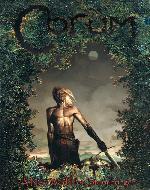
"Corum" is a soft-cover 166-page book. The black-and-white interior art is good : it's not always very classy but it perfectly illustrates this strange world. The maps, especially, are very evocative and the chaotic characters have kewl leather armours which would amaze the average WoD character. The cover is a neat painting depicting Prince Corum, looking horrified (or surprised or angry), holding a sword in his famous alien hand.
The layout is clear (yet dense), the writing style is OK, and the book is quite comprehensive : the NPC catalogue is impressive, there are three scenarii, there's even a short guide to design your own Multiverse plane ...
Let's examine the book's chapters (called “Encyclopediae”).
* * *
ENCYCLOPEDIA MECHANICA
This chapter contains, in some 20 pages, the rules to create a local character.
The first section is named “Adventurers” and details the creation of a character, step by step, for the different peoples : Barbarian Mabden, Civilised Mabden, Nhadragh, Raga-da-Kheta, Shalafen, Vadhag. The Mabden are plain humans, so they are not detailed, but the Elder Races all have their special skills and “magic”. A 2-page character sheet is included in this section.
The Vadhagh (cousins to the Melniboneans of Elric's universe) are faithful adaptation from Moorcock's books. The other races only appear very briefly, and the authors had to extrapolate ; the result is very convincing and the Nhadragh (ancient rivals of the Vadhagh, now a nearly-extinct race), Raga-da-Kheta and Shalafen are full-fleshed civilisations, not just sword-fodder.
“New and Changed Occupations” details all professions (not only the new ones), along with their skills and starting money. As opposed to Elric, no magic is proposed, except for the Sorcerer (practitioner of Sorcery) and the Seer (practitioner of Contriving).
“Allegiance” is a page detailing the differences between Elric/Stormbringer and Corum concerning Apotheosis (becoming Champion of Law, Chaos or the Balance).
“New Knowledge” details some new skills, and explains skills differing from their equivalent on the Young Kingdoms. It's an interesting part, with details about languages, Advocations of the Vadhagh (complete knowledge of a trivial or esoteric subject) and other specific skills (I love the skills of the Shalafen : Surfing, Whale-Talk ...).
“Weapons” describes local weapons and armours.
“Transports” gives details and stats about boats (giving some 25 examples of boats following the rules given in “Sailing the Seas of Fate” for Elric) and Chariots (six examples). New (and simple) rules are given for chariot chases and fights, which perfectly fits this Celtic world.
* * *
ENCYCLOPEDIA COSMOGRAPHICA
This chapter is 30 pages long and describes the setting. It is divided into three sections named “Historia”, “Geographia”, “Cosmology”.
The “Geographia” part is the longest one, and every important place on this world is discussed (all places which name appears in Moorcock's books, plus of course some imagined places). There's a map of the World, and small maps for the bigger cities (Gor-an-Glu, Kalenwyr, Arke, Halwyg-nan-Vake). It's a well-done development of Moorcock's ideas and an interesting read, with many encounter or campaign ideas, and descriptions of some places (a typical Vadhagh castle, for example).
“Cosmology” describes the gods and religions of this world.
* * *
ENCYCLOPEDIA CONJURATORIA
This chapter deals with magic in the world of the Five Planes, in some 30 pages.
“Sorcery” deals with Chaotic Magic : Sorcery, Ragha-da-Kheta Fetishes, Summoning Chaos Creatures, Summoning (Greater) Demons. It also explains chaotic traits (mutations caused by Chaos) and the use of Sorcery on other Planes.
“Contriving” discusses the magic of Law : Contriving and Elemental Tatoos.
Sorcery is completely different from magic in the Young Kingdoms (Elric's universe) : it is not a natural part of the setting, but something completely alien, a gift from extra-dimensional entities. The Sorcerers learn “Chaotic Effects” (not exactly spells). They cast “Chaotic Melds” (mixes of Chaotic Effects) and may add some magic investment to augment duration, range, etc. For example, if you want to sprout a tentacle which does 2d8 damage (that's a level 2 Tentacle effect) and absorbs 1d4 STR per round (level 2 of the Vampire effect), that will cost you 12 magic points (3 points per level) for a duration of 1d8 rounds (17 magic points for a duration up to one hour). The book gives some forty funky Chaotic Effects, some of them really looking like super-powers (wall-crawling ! webbing ! ...) and some of them adapted from classic spells (Fire, Make Whole ...).
This Chaotic Magic is very risky : the Sorcerer quickly accumulates Chaos points, which have unpleasant side-effects in Corum's World (ugly mutations). Also, this magic is not very fast ; the sorcerer has to gather the Effects before casting them. And, finally, it is not reliable : every Effect requires a Luck roll (failure : you've wasted your Magic Points), and fumbles are really messy.
Summoning is also a possibility, but is very different from the one used in Elric/Stormbringer. It's impossible to summon Beast-Lords, Plant-Lords and Elementals (they don't exist) and Lesser Demons (they're too far away). Greater Demons can come, if they wish, but they can't be controlled : the sorcerer should find a good reason for such a long trip (and a nice present, too) ! The most common Summoning is to call a Chaos creature : these are not really Demons, just beasts from a nearby Chaotic plane. They will generally ask for a present and can be somewhat controlled. They can also appear spontaneously, when someone rolls 2 fumbles in a row ! (This funny rule is inspired from Moorcock's sentence at the beginning of the saga : “It was a time of [...] misshapen creatures who could be summoned by an ill-considered thought.”). Some fifteen sample beasts are detailed.
Contriving is the local super-science. The character can learn the Precepts : Plane-Shifting, Quality, Mechanics and if they want to combine these Precepts, they have to learn Combination. Some Contrivances (especially those build with Combination) need some energy to power them : this energy typically comes from crystals.
- The Precept of Plane-Shift allows perception of nearby planes, travelling to these places, and other associated powers (invisibility, passing through walls, etc.). It also makes it possible to build Contrivances using those abilities (invisibility cloaks ...).
- The Precept of Quality is for building perfect items, eliminating their randomness and augmenting their resistance.
- The Precept of Mechanics is used to create “clockwork” machines, but those Contrivances are generally fragile (unless Combined with Quality). Complex Mechanics also require Combination.
- Combination is the art of mixing 2 or 3 Precepts in the same object. For example, a mechanical warhorse which rides through the planes should Combine all 3 Precepts (2 at least, but Quality is advisable).
The three Precepts (and Combination) are hard to learn, though it is easier for the Vadhagh (they Plane-Shift naturally, but still need to learn the Precept if they want to use it in Contrivances). Once learned, the precepts automatically work. Contriving is time-consuming but a quick Contrivance is possible (a Chaotic perversion ...). Contriving uses extremely simple and clever rules (the rules are 6-page long) for this very inspired super-tech which perfectly blends in the setting.
Compared to “Adventure!” another recent game featuring super-science (and crystals), we can say that Corum's Contriving is globally less flexible and powerful, except for the Plane-Shift Precepts, which permits amazing feats (invisible weapons, multiverse travel ...). Of course, the chapter details some examples of Contrivances, complete with stats and costs.
One page is devoted to each minor magic (Elemental Tatoos and Fetishes, along with simple rules and examples), the chapter also discusses Chaos Traits, the mutations which strikes those who ally with Chaos (not necessarily by wielding Chaotic Effects).
* * *
ENCYCLOPEDIA MASTERIA
This chapter contains tools for the gamemaster. It is the longest chapter of the game, totalling more than 60 pages.
The first section “Running the game” contains advice to the GM, and some other information (secrets of the Nadragh ...). A lot of sample adventures / campaigns are suggested, focusing on heroic deeds (fight tyranny, save the world ...). There's also a 2-page guide to create your own universe, complete with random charts and advice.
“Exotic Treasures” details strange products or objects, not necessarily magical.
“Inhabitants” is a 18-page series of NPC's and Creatures, complete with stats and descriptions : 8 monsters, 23 generic NPC's (the “Five Planes Digest”) and 21 NPC's from the book.
Three complete scenarii follow. I have not playtested them, but they look very interesting. The first one (Jeweled Destinies) involves a chase for an ancient (and sentient) artefact. The second one (The Prince Who Cried for Love) mixes an impossible love story (between a Vadhag and a Mabden), a ghost story (kind of) and family conspiracies. The third scenario (A City That is Not) is a travel to a lost city and a detailed description of this setting (which begs to be used for a long series of adventures).
The books ends with play aids : a blank map of the world, a 3-page summary of rules for Sorcery and Contriving, a 2-page Character Sheet.
* * *
COHERENCE
The book is well-organised and a very pleasant read.
The art perfectly fits the nearby text, with some exceptions (like this guy in the first scenario who is supposed to have short hair, but is drawn with long hair).
The NPC's description illustrate the rules, especially the generic ones. Like in Elric, the important NPCs generally do not wield magic, except a few of them which know all Chaotic Effects ... Anyway, the Magic rules perfectly fits the universe, and even if they somewhat detracts from Moorcock's writing, it's with good reasons, like in Elric/Stormbringer.
There are some small mistakes (nothing really important), but an errata is available on Darcsyde's site, along with a series of FAQ's.
* * *
CONCLUSION
This is an excellent book, from a promising Australian company.
"Corum" is based on Moorcock's first trilogy featuring the Prince with the silver hand. An expansion on Elric / Stormbringer / Hawkmoon games, it easily allows for universe shifting or alternate campaigns.
It is a very well-done book, with clever rules, detailed background, lots of NPCs and three good scenarii. The authors managed to capture the spirit of this universe, developing the themes into a rich and coherent world, a brilliant counterpart to the Young Kingdoms.

